Thursday, February 14, 2019

Garibaldi BS

Happy Valentine's day, a time of friendship and goodwill.

So it is nice to see that it has been 106 days since Garibaldi last released any drill results from Nickel Mountain (link).

We were nicely told back in December (link) that they successfully completed the first full season of drilling, producing 11,573m of core.

So we are still waiting for results from 22 holes, or 2/3 of the program, which as GGI tell us:


Damn, you guys must be really slow if it takes you that long to interpret the results.....

Maybe we'll get something in time for the PDAC....

Friday, February 1, 2019

Sun Metals - Stardust in Central BC

There are very few 'new' discoveries being made, and most junior explorers are flogging dead dogs that have been around for such a long time that most you can ignore.

This was my initial opinion of Sun Metal's Stardust project, it had a tiny resource but has had a lot of work done on it, ~398 RC and diamond holes, or ~70Km of drilling.

Not much here


What a POS - a small, low-grade, well explored project in the middle of nowhere. The didn't seem to be much potential in the existing resources. They appeared to consist of a series of narrow, variable grade zones that have had the crap drilled out of them. 

lots of narrow zones

So where were Sun Metal's going to find more mineralization? Projects like Stardust are quite common for it to go any further, you want to see some potential that it could host resources around >10Mt @ >3% CuEq to get a mid-tier miner (e.g. Crapstone) involved.

I'm just focusing on the skarn mineralization. I know that the project has several other mineralization styles, but they aren't the focus on the technical report, which suggests that they aren't important economically. You can get the 3D model from here (link), there was only a small proportion of the historic data that I could get in.


For those getting massive erections from the Porphyry zone, it has been drilled and no results are mentioned in the technical report, so I assume that it is unmineralized, but the lack of mineralization in it could be:

  • Negative (the majority of intrusive rocks) the magma that formed the stock was relatively metal poor, and therefore any mineralization associated with it will be small and uneconomic.
  • Positive (e.g. Santa Eulalia, Mexico; Taylor, Arizona, Las Bambas, Peru to name a few) – the stock was emplaced into a reactive rock (the limestones) that 'sucked' out all of the metals to form large skarn/CRD bodies leaving the behind an unmineralized porphyry.
However, the recent drilling (link and link) did look interesting. I wanted to check that they were doing more than confirmation drilling, i.e. twinning good old holes to con people into believing that they had found something new.


Simply put, they did a bit of both. Tested the known zones (probably because the historic core is missing), and they tested a few geophysical targets.

The good news that came out in October was from a confirmation hole (i.e. one that was drilled into an area that had been drilled before), and we got this section.


We can clearly see that the majority of the skarns are hosted in narrow limestone units within the phyllite package, which explains the narrow, irregular nature of the resources, which is not a good situation if you want to find a big deposit!


However, drill-hole 18SD-421 was good, it drilled through the phyllites and passed into the underlying limestones where it intersected 2 previously unknown, thick, high-grade skarn/massive sulfide zones.

This is great news as it shows that Sun Metals has found something new, rather than rehashing old news, and it appears that this phyllite-limestone contact is virtually undrilled! This zone appears to be open in most directions, especially up-dip.

The down-dip potential could be limited by hole LD2010-02 that may have drilled the down-dip continuation of this zone but hit nothing, but the hole may have been terminated before hitting the mineralized horizon.

I don't know the ground conditions at Stardust, but maybe there is an opportunity to reenter and extend holes 013 and 016 to drill through the phyllite-limestone contact as this would allow them to quickly determine (in 2D) the orientation and up-dip extent of this new skarn zone.

In summary, Sun Metals have a well explored project, but the discovery by hole 421 has identified a new target that has returned the highest-grade and thickest skarn intercepts on the project. However, with just a single hole intersecting this zone it is very hard to determine its size potential. 

In addition, they may want to look at conducting a down-hole geophysical survey, for example Mise-à-la-masse that has been used successfully in many other polymetallic sulphide deposits to determine its lateral extents.

Wednesday, January 16, 2019

Serengeti - Buffing the Banana

Someone asked me to look at Serengeti's Kerwanka project in BC.

You have to give credit, Serengeti's team have been hard at pounding the the bald-headed moose, cranking the shank, and feeling their way around Kerwanka.


However, the problem with dancing with the one-eyed driller is that once in a while you have to consulting with your silent partner to see if the project is good enough for a one gun salute.

So why don't we stop serenading Mrs. Palmer and her five daughters by letting go of the one-stringed guitar and have a look:


what a load of crap
Wow, the open pit resources are terrible and the the underground "resources" are just a Cu(m) stain.


So basically, they could define >10 billion tonnes at a similar grade and it would still be too shit to put into production.

For amusement, here is the Kerwanka underground resource plotted against the mighty proposed block cave operations

Well, someone has to come last...

So basically, all that hard work milking the moose, fly fishing and hoisting the petard still means that the project is crap. That's enough to make the the bald man cry


Tuesday, January 15, 2019

Pretium - another Brucejack fail

Joseph Ovsenek must be feeling a bit of a twat at the moment, not only did he tell us back in September that (link):

[Pretium quote]

They failed to do this (link) by falling 5% short of their lower guidance expectations, and just to top off the good news, we get a nice PR investigating the trading it is shares (link).

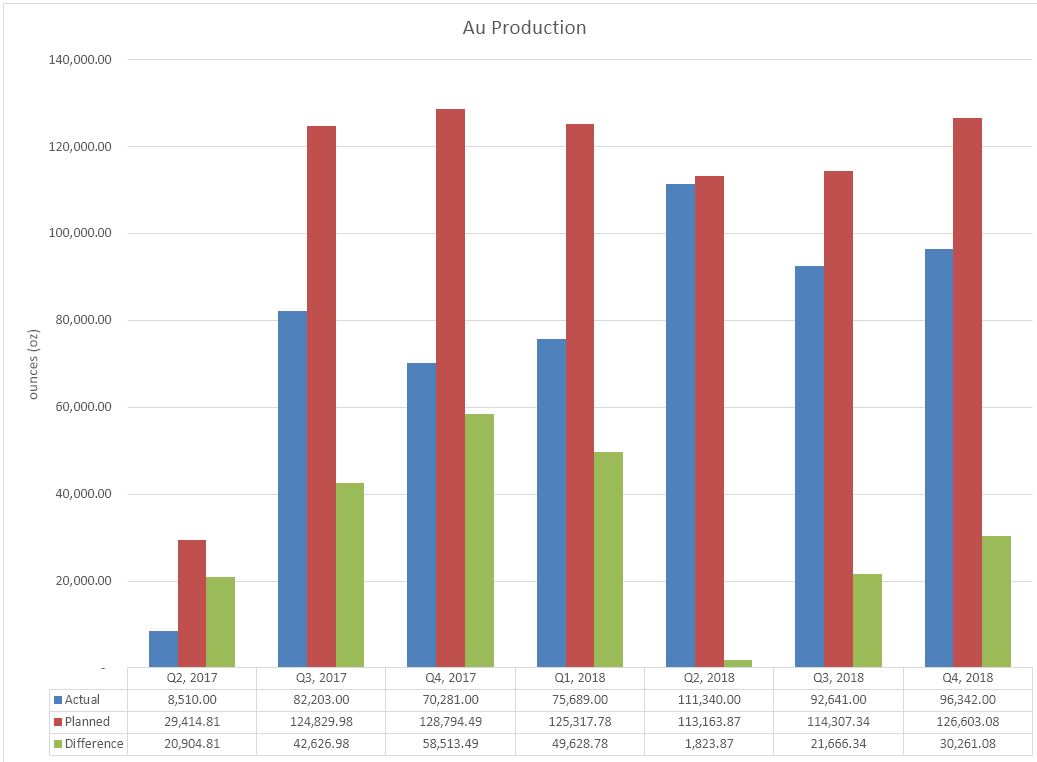
So how bad were the Q4 numbers?


Pretty shitty, there has been a consistent decline (but like my school grades) since the mine reached steady state production and the new grade control system came into place.

It is almost as if Pretium, by some coincidence managed to be mining some high-grade zones the same time. How fortunate.....

We can clearly see that only once (Q2), did production come close to the Feasibility Study number, and Q4 was a huge miss.


My bug concern, and I've mentioned this a few times, is what will happen to the grade once they ramp up to 3,800 tonnes per day?

If they manage to maintain the same average head grades (11.98 g/t Au) and recoveries (97%) that they achieved in 2018 (around 11.98 g/t Au) after the expansion we should expect quarterly production to be around:

  • (90 x 3800 x 11.98 x 97%) /31.1 = ~128,000 oz per quarter
Ironically, this is approximately what they would have been mining if they had managed to match the grade in the Feasibility Study. 


However, the common thing that happens when a mind finds itself with a hungry hungry mill, it that they chuck any old crap into it and the grade plummets.

I wonder what will happen here?


Sunday, December 23, 2018

SolGold - the beast gets bigger.....

DISCLOSURE - I've sold my Solgold shares as I regard the story at Alpala as being complete. I don't see an upside to the stock in the short-term and I'm not convinced that the deposit is big enough, at current metal prices, for a major to take them out and develop it.

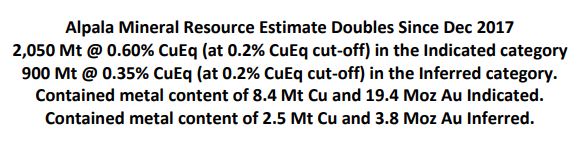
So, SolGold put out an updated resource statement for Alpala (link).

On the surface a massive jump on the previous numbers.

The Contained Gold number should be Moz not Mt
Please note that a lower cut-off was used for the 2018 resources - 0.2% CuEq vs 0.3% CuEq in 2017.

So what? They have nearly 3Bt of resources at overall grades that, even if it was at surface, would be regarded as being marginal.


When you strip out the high-grade (>0.9% CuEq) core, hat you have left is crap:
  • 2530Mt @ 0.28% Cu and 0.13 g/t Au or 0.37% CuEq
At those grades, even it was forming a nice green hill, it isn't good enough, and wouldn't be unless Cu was >$4/lb.

Let us look at the high-grade zone

I used the 0.9% CuEq values in the table, so they have:

  • Indicated - 400Mt @ 0.9% Cu, 0.93 g/t Au or 1.49% CuEq
  • Inferred - 20Mt @ 0.72% Cu, 0.52 g/t Au or 1.05% CuEq

Here it is


best areas start at ~750m depths

You can see that the bulk of the high-grade resources are in the central zone, which has been extensively drilled, and doesn't seem to have much expansion potential.

The Alpala Southeast zone appears to be defined by a couple of drill-holes, and is open in several directions, but it doesn't look to be very big.

We see the same with Alpala NW and Trivinio, but man is it deep.

The project that I was hoping to see some results from Aguinaga was a bust, and basically used the latest resource update as an opportunity to take my (small) profits and walk away, as for me, this is where the project doesn't quite make it. I've annotated a nice summary chart from Macquarie's nice summary on various block caving proposed projects (link), and we see:


I hope that Newcrest come in and take them out (link), but with the grumblings from Ecuador regarding their permitting issues (link), for me the story is over, especially as they'll need to raise more funds for their, in my opinion, extremely expensive exploration programs.


Tuesday, December 18, 2018

GT Gold - more holes in the (North) Saddle

We've had a new PR from GT Gold (link). Some interesting results, but the market didn't like them.

Summary:

Good News

  • The >0.5% CuEq mineralization appears to come to surface (hole TTD108)
The Bad News
  • High-grade mineralization restricted to a specific zone (the Stock-work zone)
  • This zone appears to be discontinuous (i.e. it doesn't seem to join up well between drill-holes), and the best zone is deep
Overall, I don't see, from the data presented, much evidence that the North Saddle zone will grow into something huge. The best mineralization appears to be inconsistent, with the best intercepts at depth.

In More detail....

In my last post I was partially correct about a preferred 'trend' in the mineralization. In fact, on the sections provided in this PR we can see that virtually all of the good mineralization is found in a specific 'unit' - what is labelled as the intense stockwork zone.

I've highlighted on the sections that accompanied the PR.


You can clearly see why hole TTD098 missed. It was drilled parallel to the stockworks just clipped it. Imaging if this hole had been drilled a degree steeper, it would have hit >300m @ >1% CuEq. The market would have liked that.

From the sections I've tried to model this zone in 3D (file here - link).


We can see that the stockwork zone is:
  • Narrow (~max thickenss 250m)
  • inconsistent (forms separate, probably discrete zones)
  • Steeply dipping to the SW
Unfortunately, for me, I can't see how the Stockwork zone is going to get much bigger.

  • On section 5620 (the most northwesterly section) the zone is very narrow and runs along the fault.
  • On section 5830 (the most southeasterly section), the stockwork zone again is very small and deep
  • Only on section 5740 do we get 2 zones
    • upper narrow zone (hole TTD106 and 108 - approx 100m wide) that continues to surface
    • lower deep zone (TTD093) that starts at 400-450m depth, that is ~200m wide
We have to remember these section are ~160m apart, which makes that stockwork zone quite small.

I'm certain that hole TTD109 will get something great (probably 400m @ >0.75 g/t Au and 0.5% Cu starting from 700m depth), but so what. All it will be doing is confirming what was hit in hole TTD093, it won't tell us anything new, we already know that they have some moderate mineralization at depth. To be special and make this project, hole 109 need to get something special.


Monday, December 10, 2018

And now for something completely different....

I should have read the PR properly!

A rehash!

A massive shock, BHP released some exploration results....

This either means two things
  1. They're fecked and desperate for Eric Sprott's cash
  2. They've found something huge and they want to show-off
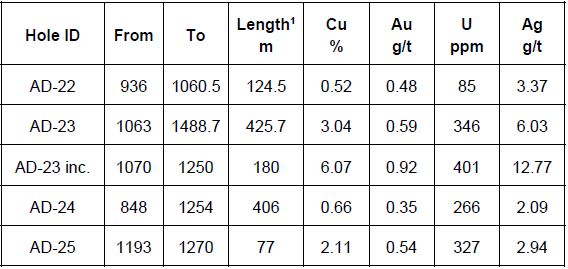
There wasn't much to go on from the PR, just some assays ...

obviously hole AD-23 included an intercept of 1m of 180% Cu...

Why don't we compare this against the discovery hole for a small deposit called Olympic Dam.

Source: Geology for Investors (link)
Here is the data in Leapfrog (link).

First thing, it is quite deep...

1.2km depth, I wonder if they'll have more water to pump than Platosa?