As we are drawing to the end of Q2 (or H1) for 2018 and we are all looking forward to Pretium's Q2 production figures from Brucejack, I've decided to do some edumacation.
Here is a nice article on evaluating high-nugget effect gold deposits like Brucejack, Pilbara etc. It is packed full of geo-porn (too explicit to reproduce here), so open the Kleenex, get something to lubricate your parts and have a gander.
Here is the link
Showing posts with label gold. Show all posts
Showing posts with label gold. Show all posts
Sunday, June 24, 2018

Tuesday, November 14, 2017
SolGold Update
DISCLOSURE: I own shares in Sol Gold, and before you ask, I'm irritated that they did a financing at GBP0.25p.
Well we are moving into the home straight, we've been promised a maiden resource by the end of the year (link), so it was nice to get some more drill results to have a look at. You can download my 3D model here (link) and open it in Leapfrog Viewer.
Obviously, we are all waiting for the initial resource calculation that was promised by the end of the year. We've only got a couple of weeks before the Christmas party and tax sell-off season starts, so it will be interesting to see if SolGold can deliver.

I not going to say that there are 2 porphyry centers (I haven't seen the drill-core or any interpretative geological plans for the project), so I've done some doodling on the map that accompanied the PR.
So I'm quite excited about holes 30 and 30-D1. If they come back with some decent intercepts my stupid idea alternate interpretation could be correct, it could have a nice positive effect on an undated resource calculation in 2018, as these holes won't have been completed by the time the initial 43-101 resource is published in the next few weeks.
If we look at the holes individually, and again, I only have the data in the press release to work with, so it is incomplete and a best guess.

We can see that hole 026-D1 hit a decent zone of material grading >0.7% Au and >0.45 Cu. My feeling on why the Au zone appears thicker is a effect on how the data has been reported, and we would see a >1g/t zone from 1400m to 1550m but it wasn't split out in the PR.

Hole CSD-17-028 was drilled between holes CSD-16-021 and 022, so I'm assuming that it was an infill hole to provide more confidence in these intercepts. It returned very similar results to hole 021.

I regard this statement as a BS, the recent drilling didn't do much to their resources, and I don't know why they are mentioning that they want to define a billion tonnes at 0.9% CuEq at a 0.3% CuEq cutoff. That puts it firmly in the uneconomic category for an underground block-cave.


So according to Macquarie, for a 0.9% CuEq block cave to give an IRR of 15%, it will need to have Cu at >US$3.5/lb and Au >$1750/oz.
Personally, I'll be looking at the size and continuity of the >1% CuEq cutoff resources.

So, I'm not sure that they'll get to their billion tonnes, but I'm convinced that my model is under reporting the narrow-high-grade zones.
Well we are moving into the home straight, we've been promised a maiden resource by the end of the year (link), so it was nice to get some more drill results to have a look at. You can download my 3D model here (link) and open it in Leapfrog Viewer.
Obviously, we are all waiting for the initial resource calculation that was promised by the end of the year. We've only got a couple of weeks before the Christmas party and tax sell-off season starts, so it will be interesting to see if SolGold can deliver.
Summary
- Infill holes, duplicating and extending to depth known mineralization
- Is hole CSD-17-028 hinting at a core of a system just to the south (currently being explored by hole 030)?
- Hole CSD-17-026-D1
- Similar grades to adjacent hole CSD-14-009
- high-grade lower zone (from 1150m) looks to be quite consistent
- upper zone looks to be quite narrow, and may link up with the high-grade zone in hole 14
- Hole CSD-17-028 - drilled between holes 021 and 022, similar grades and thicknesses
Geology Drivel
Even though these results are groundbreaking, just extending and exploring known zones, they do appear to show that in there could be more than one grade center at Alpala. I also hate that they don't highlight where the holes are located.
I not going to say that there are 2 porphyry centers (I haven't seen the drill-core or any interpretative geological plans for the project), so I've done some doodling on the map that accompanied the PR.
 |
| WARNING: Geology doodles by an insane, de-bearded geologist |
If we look at the holes individually, and again, I only have the data in the press release to work with, so it is incomplete and a best guess.
Hole CSD-17-026-D1

We can see that hole 026-D1 hit a decent zone of material grading >0.7% Au and >0.45 Cu. My feeling on why the Au zone appears thicker is a effect on how the data has been reported, and we would see a >1g/t zone from 1400m to 1550m but it wasn't split out in the PR.
Hole CSD-17-028

Hole CSD-17-028 was drilled between holes CSD-16-021 and 022, so I'm assuming that it was an infill hole to provide more confidence in these intercepts. It returned very similar results to hole 021.
Resources
I've hidden this at the bottom of the post. I'm not 100% (or even 50%) confident in my officially bad resource guesswork for Alpala, but I wanted to include the table to see what numbers I come up with to see how SolGold will get to their:
I regard this statement as a BS, the recent drilling didn't do much to their resources, and I don't know why they are mentioning that they want to define a billion tonnes at 0.9% CuEq at a 0.3% CuEq cutoff. That puts it firmly in the uneconomic category for an underground block-cave.


So according to Macquarie, for a 0.9% CuEq block cave to give an IRR of 15%, it will need to have Cu at >US$3.5/lb and Au >$1750/oz.
Personally, I'll be looking at the size and continuity of the >1% CuEq cutoff resources.

So, I'm not sure that they'll get to their billion tonnes, but I'm convinced that my model is under reporting the narrow-high-grade zones.
Friday, July 28, 2017
Newrange gold - Pamlico
There have been several spectacular drill results released by Newrange Gold Corp from their recently acquired Pamlico project in Nevada.
June 19th (link)
July 7th (link)
Some cock-stiffening intercepts, and Newrange have nicely included some geo-porn
BTW - did you take that photo 4 years ago or forgot to change the time on that fancy new camera? It is true the ideas of march were unlucky in 44BC....
Let us put the data through the de-intervalator:
Newrange have done a David Copperfield! All that beautiful gold has disappeared. Why?
You've guessed it, we have some beautiful examples of grade smearing. I would hate for a nEwsletter wrIter to have been confused by the press releases and think that there was potential for a high-grade disseminated deposit!
That big green hole is hole 17, my favorite:
Note: 0.396 g/t Au = Waste (unless you're Coeur, when it represents a 'buying opportunity')
So to put it bluntly - 89% of the gold in 7.5% of the rock. No disseminated potential here, but it isn't all bad news, they have a ramp going into that zone, and so I wanted to understand the controls on mineralization.

Sometimes you can do cool stuff when working in 3D and I feel that many exploration companies are missing a trick if they stay in Flatland (ask A Square) when looking at the exploration data.
June 19th (link)
 |
| fap |
July 7th (link)
 |
| fap fap fap fap fap fap |
Some cock-stiffening intercepts, and Newrange have nicely included some geo-porn
 |
| This picture was sponsored by Vaseline for dry and sensitive skin.... |
Summary
- Massive grade smearing, gold is found in high-grade structures
- No strong evidence for a large disseminated deposit.
- Small areas of disseminated mineralization mineralization found where multiple structures intersect.
- Poor drill program execution - no real testing of structures, drilling appears almost random
- RC drilling in a narrow structure gold deposit = cheap and nasty. Important controls on mineralization may be very hard to determine from small rock fragments.
- RC drilling can also lead to significant grade smearing if not conducted carefully.
- Next to the western hemisphere's largest munition storage facility
- Negative: US military may not like explosives being next to its dumps
- Positive: May be able to get cheap explosives
- There has been significant prospecting around the project, there could be a chance to develop several several small high-grade zones into a moderate sized resource.
Rock Rant
I'm very disappointed with the drilling. Newrange are using RC drilling to explore the project. I understand that it is quick and most importantly, cheap, but you end up losing so much information.
The holes appear to be almost randomly orientated - what are they actually trying to drill?
They have the mapping and sampling from the ramp that identified 2-3 gold bearing structures.
 |
| red dashed line = traces of structures in the ramp |
Why didn't they follow those along strike to see where they go? It looks like they have been very lucky, or do we have a forgiving, disseminated gold deposit?
Let us put the data through the de-intervalator:
 |
| ta daaaaaa! |
Newrange have done a David Copperfield! All that beautiful gold has disappeared. Why?
You've guessed it, we have some beautiful examples of grade smearing. I would hate for a nEwsletter wrIter to have been confused by the press releases and think that there was potential for a high-grade disseminated deposit!
That big green hole is hole 17, my favorite:
- We go from: 70.89m @ 3.57 g/t Au
- To: 65.54m @ 0.396 g/t Au surrounding a couple of high-grade zones running
- 4.58m @ 48.3 g/t Au
- 0.76m @ 35.4 g/t Au
Note: 0.396 g/t Au = Waste (unless you're Coeur, when it represents a 'buying opportunity')
So to put it bluntly - 89% of the gold in 7.5% of the rock. No disseminated potential here, but it isn't all bad news, they have a ramp going into that zone, and so I wanted to understand the controls on mineralization.
 |
| Pam's varicose veins |
From this I built a vein model to see if the thick hits were from wide, high-grade veins or some luck from drilling down the vein (so a wide apparent width). The veins were modeled by projecting the information mapped in the decline and linking them up with assays along strike.
Plan view

So we have 3 principal veins
 |
| Holes drilled sub-parallel to veins = long intercepts! |
The cool thing is, when you bring all those veins together, you get this:
 |
| Red box = area of thick >1 g/t Au intercepts |
By building up a decent 3D model you can start to see how the pieces fit together. There is a small zone of >1 g/t disseminated mineralization where the 3 structures come together. The nice thing is that it is close to the ramp, which provide Newrange the potential to define a small tonnage "bulk sample" that they could extract and process to generate some news and maybe some loot.
Here is my Palmico model (link)
 |
| highest gold values where the veins come together, that's original |
District potential
This is what is interesting about Pamlico. in the initial drilling there hasn't been much evidence to support a large, disseminated deposit, but with careful, focus drilling (with a fecking core rig) Newrange may be able to define several small, high-grade zones that could hypothetically feed a small operation.
If you look at the entire district (and I am assuming that Newrange has most of it), you can see:
 |
| a metric feck tonne of veins |
There are heaps of workings, following veins/structures for >1km along strike. There could be many, small high-grade zones there.
Monday, July 3, 2017
Hole 23
DISCLOSURE: I own shares in Sol Gold.
Question: What is the easiest way to find a million ounces of gold!
Answer: Drill a hole through the guts of a high-grade copper-gold porphyry
 |
| Each of those squares measures 300m |
Here are the updated official bad resources:
 |
| A nice jump-up in contained metal! |
- Cadia: 1.5BT @ 0.47 g/t Au, 0.27% Cu
- Hudo Dummit: 500Mt @ 1.66% Cu, 0.35 g/t Au
- Resolution: 1.8Bt @ 1.54% Cu
 |
| Brown = brownfield projects; green = greenfield projects |
Brownfield
- Satellite, high grade deposits next to an active open-pit mine
- Depth extension of ore-bodies that were mined by an open-pit but now is too deep to be mined from an open-pit
Greenfield
- standalone development projects
The reason I highlight this is that the cost to developing a brownfield deposit next to an active open pit mine or going underground to mine the deeper part of the same deposit a lot cheaper than building a new mine one from scratch. This also means that brownfield projects don't need to be as large or as high-grade to be developed.
At the moment, Alpala isn't quite big enough or high-grade to be a stand-alone operation, a few more holes like 23R will help! However, this is where the other exploration targets come in.
 |
| From Sol Gold June presentation |
At the moment, all drilling has focused on Alpala, let us have a look at Aguinaga.
 |
| the hair nicely outlines the Cu mineralization found in a porphyry |
We are told that they plan to start drilling there later this year. From Surface mapping and sampling they found some nice juicy rocks at surface, that look very similar to what they have been drilling at depth at Alpala.

Here is Aguinaga and Alpala. What Sol Gold are drilling at depth appears to exist at surface at Aguinaga.

Imagine what would happen if they found another Alpala at Aguinaga?
Tuesday, May 2, 2017
Solgold - update
DISCLOSURE - I own shares in Sol Gold. I'll try to make this post unbiased, but I want everyone to buy lots of shares so that I can make some money!
We got some news a couple of weeks ago that gave us the final results for hole 21 and a PR today with some visual results from hole 23R, 24 and 25.

Hole 23 was drilled right through the middle of Alpala and will get some great results. Holes 24 and 25 were drilled to test the SE continuation of the Alpala system. They hit ever decreasing thicknesses of gradually lower grade mineralization, which is what you would expect as you move away from the core of the system.
Here are the updated official bad estimates

We got some news a couple of weeks ago that gave us the final results for hole 21 and a PR today with some visual results from hole 23R, 24 and 25.

Hole 23 was drilled right through the middle of Alpala and will get some great results. Holes 24 and 25 were drilled to test the SE continuation of the Alpala system. They hit ever decreasing thicknesses of gradually lower grade mineralization, which is what you would expect as you move away from the core of the system.
Here are the updated official bad estimates

- Copper increased to 1.9Mt
- Gold increased to 4.95Moz
Looking good, but we see that there is a smaller increase in high grade (>0.6% Cu and 0.5 g/t Au), which is the material that will be mined via and underground block-cave operation.
My prediction:
- Hole 21 - 925m @ 0.5% Cu, including a 400m >0.6% Cu - hole only 100m from hole 16, which hit a lot of good stuff
- Hole 23 - being drilled, target between holes 16 and 19, so I'll expect
- 200m >1% Cu and 1 g/t Au (@ 1,000m depth), within a 1000m zone of 0.3-4% Cu and 0.2-0.4 g/t Au
Actual
Hole 21
- 844m @ 0.73% Cu and 0.43 g/t Au
- inc. 670m @ 0.82% Cu and 0.51 g/t Au
- inc. 304m @ 0.99% Cu and 0.63 g/t Au
So, I was a bit-off, sort of like my high-school review - has talent, just needs to work harder.
Hole 23
Hole 23
- 573.2m of sulfides from 563.7m depth
- at >1.4% volume percent chalcopyrite
- or a guesstimate grade of 0.48% Cu
- a higher grade zone from 979.2m to the current EOH at 1136.9m
- at >2.9 vol-percet Chalcopyrite
- or a guesstimate grade of 1% Cu
Hole 24 - 248m @ >1.1 volume percent chalcopyrite or 0.38% estimated copper
Hole 25 - 454.2m @ >1.5 volume percent chalcopyrite or 0.52% estimated copper
I calculated the guesstimate grades by taking the volume percent of chalcopyrite and multiplying it by the copper content of chalcopyrite
so 1.4 * 0.346 = 0.48% Cu
However, it is very hard to accurately measure the grade visually, so we can use these as guide to where copper is present or absent.
NOTE: I haven't used the estimated copper grade in the tonnage calculations.
so 1.4 * 0.346 = 0.48% Cu
However, it is very hard to accurately measure the grade visually, so we can use these as guide to where copper is present or absent.
NOTE: I haven't used the estimated copper grade in the tonnage calculations.
Here is the updated leapfrog model (link)
Geology
It is hard to gauge the importance of hole 24 as it is still being drilled, but from the information we're given:- Hit a narrow low-grade copper zone 400m away from other mineralized drill-hole
- 248m @ 1.1 volume percent chalcopyrite or 0.38% Cu from ~740m depth.
 |
| porphyry getting thinner to the right (SE) |
We can also see that hole 25 (454m @ 0.52% Cu) is also a step down from the high-grades hit in hole 21 in the core of the system. This indicates that we are moving away from the high grade core into the lower grade periphery.
This is normal in porphyry systems - you have the thickest, highest grade mineralization in the core of the system and lower grade at the edges.
Drill-hole 23 was drilled smack into the middle of the high-grade core, so this will get some decent mineralization, but won't have a huge impact on tonnes (see section below). I will expect it to hit good copper grades until around 1300m depth. I'm going to upgrade my guesstimate to:
- high grade (>0.8% Cu) from 980m to 1350m
 |
| Hole 23 - drilled straight through the guts of Alpala. |
Saturday, April 22, 2017
Grade smearing - Barkerville
Barkerville, that name seems familiar....
The big, fierce black dog is made to glow in the dark using phosphorus, chases a man, who runs in great fear and dies of an apparent heart attack?
ohh, crap, that was Peter George's crowning glory with "potential to host 40-90Moz of gold" (link, link and link).
So, you have a project and a company (the faces have changed but the name is the same) that had been pulled through a river of crap over a dodgy technical report. You would think that they would be extra specially good, and they wouldn't do some massive grade smearing, from a few narrow,ultra gfg*-grade veins and come up with a massive intercept that cause geologists to faint as their blood rushes to other parts of their bodies (i.e. not their geo-pick hand.....)
*gfg = geologist's fantasy grades - think of these as Scarlett Johansson** - she exists, but there is no chance you'll ever date her, but you'll be happy to sell your mate's testicles just to have the opportunity to lick her armpit
**some people may not like SJ, they are probbaly the same people that say "I prefer silver over gold". They are wrong, and should be immediately disowned.
Holy shit, they've just raised $12.5m by flogging a 0.75% NSR on a Cariboo to Osisko.
Crap, wrong PR, this is the one (link) I want to talk about....
Sweet holy jebus, 54.4m @ 19.2 g/t Au - that is US$800/tonne rock, let's start mining now...
Let us look beyond the Uber-high grade intervals, like:
Look at the moose, 9% is equal to it's back legs.
Grade smearing is endemic in exploration companies, heck, why didn't they make it 1044m @ 1 g/t for shits and giggles?
The big, fierce black dog is made to glow in the dark using phosphorus, chases a man, who runs in great fear and dies of an apparent heart attack?
ohh, crap, that was Peter George's crowning glory with "potential to host 40-90Moz of gold" (link, link and link).
So, you have a project and a company (the faces have changed but the name is the same) that had been pulled through a river of crap over a dodgy technical report. You would think that they would be extra specially good, and they wouldn't do some massive grade smearing, from a few narrow,
 |
| who ruined that picture of a gold sample with some yucky gurl's boobs? |
*gfg = geologist's fantasy grades - think of these as Scarlett Johansson** - she exists, but there is no chance you'll ever date her, but you'll be happy to sell your mate's testicles just to have the opportunity to lick her armpit
**some people may not like SJ, they are probbaly the same people that say "I prefer silver over gold". They are wrong, and should be immediately disowned.
Holy shit, they've just raised $12.5m by flogging a 0.75% NSR on a Cariboo to Osisko.
 |
| that is one expensive Ungulate, i'm guessing that Osisko bought the balls... |
Sweet holy jebus, 54.4m @ 19.2 g/t Au - that is US$800/tonne rock, let's start mining now...
*sigh*
Let us look beyond the Uber-high grade intervals, like:
- 0.5m @ 272 g/t Au
- 0.85m @ 760 g/t Au
- 0.5m @ 64.2 g/t Au
- 0.5m @ 42.8 g/t Au
- 1.5m @ 65.4 g/t Au
- 1.15m @ 15.8 g/t Au
and look but what is the grade for the other 49.5m that they don't report? What does that run?
2.5 g/t Au
Yes-sirree, just a teeny weeny 87% drop. I mean, that is still a decent result, but it shows that 87% of the gold is in just 9% of the drill-hole.Look at the moose, 9% is equal to it's back legs.
Grade smearing is endemic in exploration companies, heck, why didn't they make it 1044m @ 1 g/t for shits and giggles?
Thursday, April 13, 2017
SolGold Update
DISCLOSURE - I own shares in Sol Gold. I'll try to make this post unbiased, but I want everyone to buy lots of shares so that I can make some money!
Over the last couple of weeks we've received the results from holes 19, 20R and 22 (link and link).
The key is going to be the cut-off grades that are used to calculate the resources.
Hole 24 is going to be key, from the description (lots of pyrite and trace chalcopyrite and bornite), it suggests that it has intersected edge of a porphyry, but is it:
I did enjoy the lip-sticking (applying lipstick to tart up some average results), done by the IR department, but Hole 22 (designed to see if the Cu-Au zones goes to surface) was a classic Playtex (tm) hole - looks great from afar, but once you get it open, everything disappears.
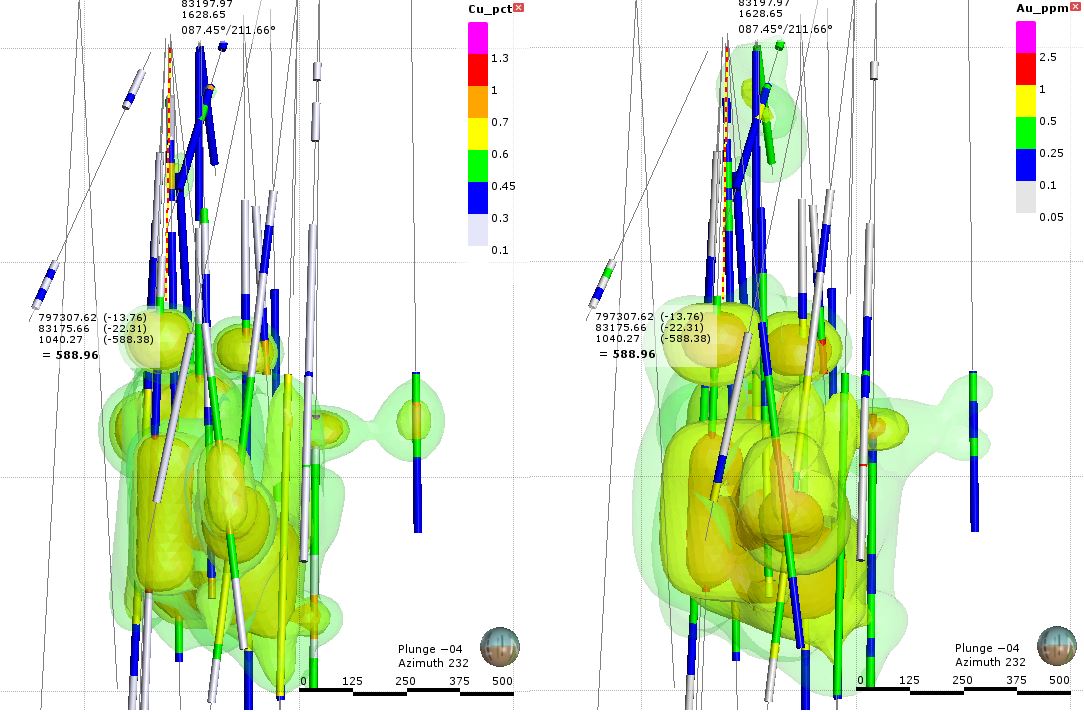
However, the results from both are what I would expect from holes that are drilling the edge of the system. We are seeing a gradual decrease in Cu and Au grades away from the center of the system (around hole 16).
you can download the 3D view from here (link)

So essentially SolGold have given you a quick way to check their results and ignore the PR headlines and look at what the data is telling you.
Over the last couple of weeks we've received the results from holes 19, 20R and 22 (link and link).
Summary
TL:DR version: Inline with expectations- Economic (>1% CuEq) mineralization is deep (~600m depth)
- Hole 19 - drop-off in grade, as you move away from the core of the deposit (hole 16)
- Hole 20 - clipped the edge of the deposit, didn't get much.
- Hole 22 - Inline with expectations - >1% zone is quite narrow (100m core length)
They are having drilling issues - several holes lost before reaching target depth, and have changed contractor to resolve them.
I'm concerned about grade-smearing. When you separate out the high-grade zones, you are often left with wide-zones of much lower grade (sub-economic?) mineralization.
e.g.
I'm concerned about grade-smearing. When you separate out the high-grade zones, you are often left with wide-zones of much lower grade (sub-economic?) mineralization.
e.g.
- Hole 22 - 730m @ 0.52% Cu and 0.23 g/t Au becomes
- 100m @ 1.1% Cu and 0.57 g/t Au
- 630m @ 0.43% Cu and 0.176 g/t Au
- Hole 19 - 1344m @ 0.44% Cu and 0.28 g/t Au becomes
- 552m @ 0.68% Cu and 0.45 g/t Au
- 792m @ 0.27% Cu and 0.16 g/t Au
This shows we have a high-grade (>1% CuEq) core surrounded by lower grade mineralization, which is normal for porphyry systems.
TAG Officially Bad (tm) resources
- Au - increased to 4.74Moz (542Koz or 13% increase)
- Cu - increased to 1.7Mt (198Kt or 28% increase)
 |
| looking good... |
Predictions
- Hole 21 - 925m @ 0.5% Cu, including a 400m >0.6% Cu - hole only 100m from hole 16, whihc hit a lot of good stuff
- Hole 23 - being drilled, target between holes 16 and 19, so I'll expect
- 200m >1% Cu and 1 g/t Au (@ 1,000m depth), within a 1000m zone of 0.3-4% Cu and 0.2-0.4 g/t Au
- Hole 24 - keep an eye on this one, 3 scenarios (2 good and 1 bad)
- Gets not much as it is drilling the peripheral part of the Alpala porphyry (i.e. lots of pyrite and not much else)
- Drills deeper and hits the continuation of the Alpala porphyry
- Drilling the peripheral part of the mineralization mapped at Malte Creek
- Hole 25 - being drilled ~100m south of hole 19, so I'm estimating
- 600m @ 0.3% Cu and 0.2% Au
- drilling below hole 003 that hit a couple of narrow zones @ ~0.3% Cu and 0.1 g/t Au
The Good
Hole 19 hit reasonable mineralization, inline with what you would expect when you are drilling away from the high-grade core in holes 12 and 16.
 |
| left = split assay results; right = super duper PR assay results |
- Part of Alpala system - they've extended it by >1km, which is huge, this could move Alpala into a >10Moz Au deposit
- If it is associated with Malte Creek target - a separate, smaller Cu-Au system. Good.
- If it is the distal part of the Alpala system - nothing changes
Gut feel - the middle one, we'll have to wait for the results to see what grades they get.
The Bad
Hole 20 appears to have clipped the edge of the Alpala system. Even though the hole was lost, I doubt that it would have got much more, so it basically tells us that the exploration potential to the east is less than thought.
 |
| left = split assay results; right = super duper PR assay results |
I did enjoy the lip-sticking (applying lipstick to tart up some average results), done by the IR department, but Hole 22 (designed to see if the Cu-Au zones goes to surface) was a classic Playtex (tm) hole - looks great from afar, but once you get it open, everything disappears.
 |
| geoporn is always crap |
 |
| left = Copper; right = gold |
The Ugly
Sol Gold are drilling 1500-2000m drill-holes. So each hole will take 2-3 months to be drilled (I'm assuming 800-1000m per rig each month). You can now see how important it is to use decent drilling contractors, as you don;t want to have invested >$100K and more importantly time into a hole that is lost before it hits the target!
Losing a couple due to poor ground conditions is expected, but the fact that Sol Gold tell us that they have changed contractors suggests something more - maybe they were using old equipment and inexperienced drillers?
Losing a couple due to poor ground conditions is expected, but the fact that Sol Gold tell us that they have changed contractors suggests something more - maybe they were using old equipment and inexperienced drillers?
Conclusion
When you split out the high-grade intervals you see that the best mineralization is deep (starting at around 600m) with a high-grade core that grades outwards into lower grade mineralization. For me, the key is to keep your eye on the 0.7% CuEq contours that SolGold put on their various sections. Fe me, this is a reasonable proxy for the economic limits of mineralization. If you carefully check Figure 6, you can quickly see the disconnect between the long mineralized intercept reported in hole 22
So essentially SolGold have given you a quick way to check their results and ignore the PR headlines and look at what the data is telling you.
What I would like to see
Some work on the other targets, it would be nice to know when they will be thinking about drilling the other targets. Alpala is now a mature exploration project and the new results aren't as flashy as earlier ones and people will start to get Alpala fatigue. It will be nice to have a rig exploring adjacent targets, as Sol Gold could find higher grade zones at surface where there will be amenable to open-pit mining.
Tuesday, March 14, 2017
Tethyan Resources
Serbia hasn't been this popular since 1999. We've lusted over the intercepts that Reservoir had been reported prior to their takeover by Nevsun, and so many junior companies are heading there to hope that there are other world-class deposits to be found while enjoying a glass of Italian Riesling.
We can see that there are a lot of deposits, and mineralization types, but only a few would you class as being any good.
A cursory glance at the data shows that for an early stage project, this is the first drilling, they hit some interesting grades, particularly gold (some consistent, sub-economic grades on its own) with a narrow zone of high-grade copper zone relatively close to surface.
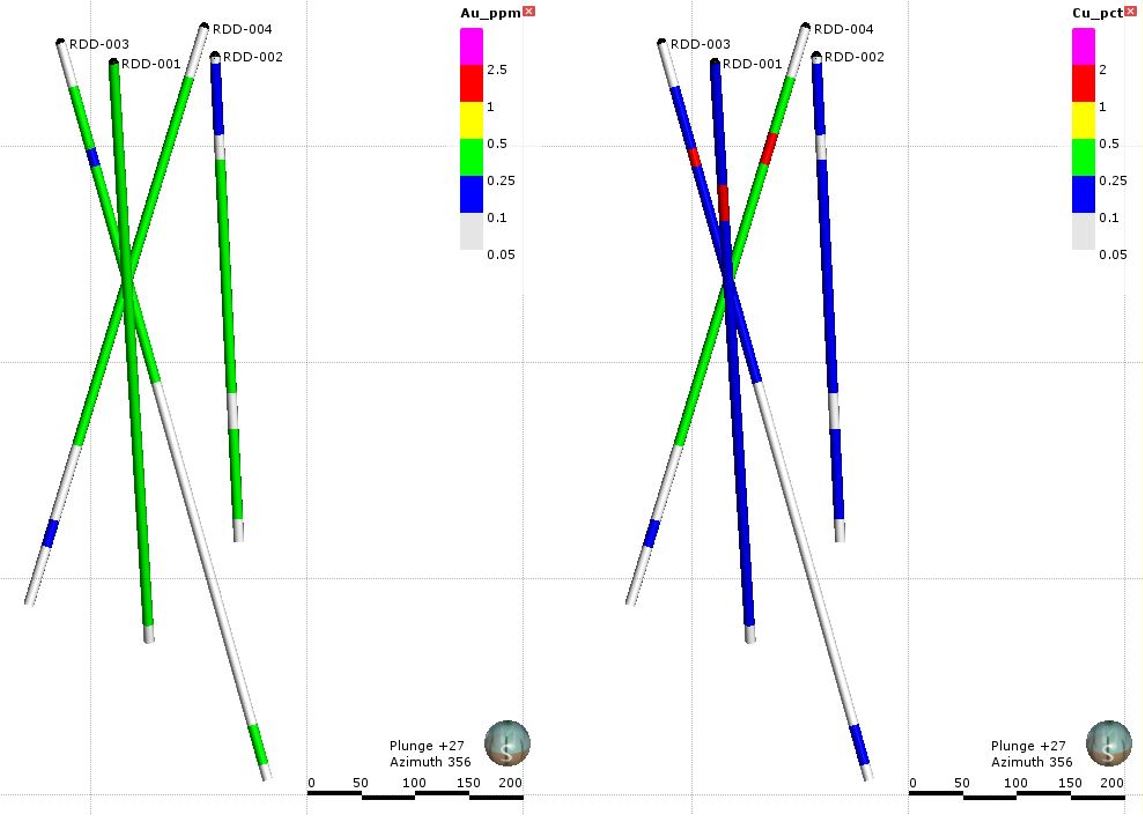
However, if you take a bit of time and look at the maps and sections on the webpage (link), you can quickly see that 3 of the 4 holes have drilled the same rock from 3 different directions, and a single hole (002) has explored for the continuation of mineralization 100m along strike, where we can see the grades drop-off considerably (3D model here - link)
Here is an annotated section, and you can see that all Tethyan have is a small, poorly mineralized porphyry deposit.The small high-grade supergene zone looks interesting, but is small and restricted to the porphyry. The main body is too low grade to really warrant further work, and the 'deeper' zone, is too deep and low grade to really be of interest.
I guess they were trying to 'better understand' the mineralization, but it is frustrating that a company that has spent all that time and money on permits, building access roads and drill-pads that they didn't do something a bit more dynamic. Why drill the same rocks from three different directions?
Let's be reasonable, we are talking about a junior exploration company, funds are tight, they had a well mineralized hole (visually) in hole 001. They did a step out (hole 002) 100m away, and it didn;t get much. So, I assume they panicked, played it safe, and went back to poking around hole 001 to make that they hit something. It keeps the risk low, but also minimizes upside.
Without having some regional geophysics maps or regional geochem it is hard to gauge the potential outside the Rudnitza porphyry. Normally companies drill the best target first. so if that is the case, they may want to spread their wings and see if they can find something better elsewhere.
So, imagine that you have just finished hole 002, it was bad, and you are thinking "what the feck do I do now"?
What would a weaselly geologist do?
Here is my alter-ego, FAG (the Fraudulent Angry Geologist), and ask him - what BS can be spun from this project?
We have to assume that the FAG has 1/4 a brain-cell and is evolved from stoats
Even better, if all 6 proposed holes hit the high-grade supergene zone you could do a nice BS resource report to define a small (200m x 200m x 30m) resource (3.25Mt @ 1% Cu or 70 million lbs of copper), and start promoting the heap leach potential. the opportunities are endless!
Tethyan, you missed a trick there!
 |
| you want to be in the turquoise and moldy lemon colored areas. |
- Bor - 2.1Gt @ 0.64% Cu and 0.24 g/t Au
- Majdanpek - 1Gt @ 0.6% Cu and 0.35 g/t Au
- Chelopech - 60mt @ 1.2% Cu and 2.4 g/t Au
- Timok - 1.7Mt @ 13.5 % Cu, 10.4 g/t Au and 35Mt @ 2.9% Cu, 1.7 g/t Au
The rest are decidedly average, but it is important to note that ALL the best deposits are found in the early morning-urine colored belt in the NE of the map (where the world Bulgaria is located)
This isn't where Tethyan have their projects. Gkcanica and Suva Ruda are found in the orange Vardar Zone that hosts some medium-sized low grade Cu-Au deposits, like:
- Tulare - 523Mt @ 0.24% Cu and 0.23 g/t Au
- Lece - 3.3Mt @ 3.7 g/t Au, 3.3% Zn, 1.5% Pb and 20 g/t Au.
This doesn't mean that there isn't a large deposit lurking somewhere in this belt, but does indicate that:
It ain't elephant country, mate
Summary
- Small low grade porphyry Cu-Au deposit drilled at Rudnitza with
- Narrow zone of supergene enrichment
- Mineral belt isn't well-endowed
Nothing here screams "major discovery", some average exploration holes, and it will be interesting to see what Tethyan do next. Will they stay-married to the project - keep spending more and more money on it as they have nowhere else to go, or start to do some regional exploration to see if they can find something better?
Geology
I am interested to see the relationship between the recent drilling and the drilling conducted by Phelps Dodge in 2004, especially holes PDRC-04-03 and 04. I'm going to guess that this drilling was designed to confirm the grades seen in those holes (does this old data exist?) and to see if mineralization continues to depth. Here are the new results: |
| Reasonable for initial drilling |
However, if you take a bit of time and look at the maps and sections on the webpage (link), you can quickly see that 3 of the 4 holes have drilled the same rock from 3 different directions, and a single hole (002) has explored for the continuation of mineralization 100m along strike, where we can see the grades drop-off considerably (3D model here - link)
 |
| Left = gold, right = copper |
Here is an annotated section, and you can see that all Tethyan have is a small, poorly mineralized porphyry deposit.The small high-grade supergene zone looks interesting, but is small and restricted to the porphyry. The main body is too low grade to really warrant further work, and the 'deeper' zone, is too deep and low grade to really be of interest.
 |
Without having some regional geophysics maps or regional geochem it is hard to gauge the potential outside the Rudnitza porphyry. Normally companies drill the best target first. so if that is the case, they may want to spread their wings and see if they can find something better elsewhere.
So, imagine that you have just finished hole 002, it was bad, and you are thinking "what the feck do I do now"?
What would a weaselly geologist do?
Here is my alter-ego, FAG (the Fraudulent Angry Geologist), and ask him - what BS can be spun from this project?
We have to assume that the FAG has 1/4 a brain-cell and is evolved from stoats
Remember - if you are investing in Junior Mining stocks, you are the Rabbit!
You saw that there was some good stuff in hole 001, not much in 002, so let us re-imagine the drilling, taking the ~1200m that was drilled in holes 003 and 004 and see what we can do!
We know that the deeper mineralization is low grade, so why not focus on the near surface supergene zone, this can be drilled with a few 150-200m long drill-holes.
That would have allowed you to release lots of press releases with 30-40m @ >1% Cu and >0.3 g/t Au. Imagine those CuEq and AuEq PR headlines, that would suck investors in.
We know that the deeper mineralization is low grade, so why not focus on the near surface supergene zone, this can be drilled with a few 150-200m long drill-holes.
 |
| proposed holes in red - >0.5% grade shell in yellow |
 |
| Plan view |
Even better, if all 6 proposed holes hit the high-grade supergene zone you could do a nice BS resource report to define a small (200m x 200m x 30m) resource (3.25Mt @ 1% Cu or 70 million lbs of copper), and start promoting the heap leach potential. the opportunities are endless!
Tethyan, you missed a trick there!
Wednesday, March 1, 2017
Kilgore - Otis Gold
Otis Gold was forwarded to me by a reader (JLB) and they recently announced that Agnico Eagle has decided to invest ~$5M in Otis (link), so what are AE investing in?
We can see an fault offsetting mineralization. This means that to the left, mineralization appears to be open, but getting deep (>150m depth), and to the right (NW) the mineralization appears to have been eroded away.
Here are some cross sections, and look how the grades change between drill-holes.


You can see that the highest grades are very restrictive, and I feel they relate to vertical faults and structures, and the gold is bleeding out along the rock contacts to form a low grade zone around these high grade structures. and this is what happens to the grade shells with different generic trends.

So you can see, very quickly how changing the trend on how the grade shells are created can have a drastic impact on the amount of resources calculated, and you have to be very careful and make sure you understand the controls on mineralization. In many cases you can't use a generic trend.
So we have a small, low grade deposit, with issues, and overly optimistic historic resource.
 There has been a lot of drilling outside of the Kilgore deposit.

And form the map above, they have identified erratic gold mineralization, up to 52m @ 1.25 g/t Au. I don't know if these holes have been followed up, and as they are RC holes, the grades are probably suspect, but it does show that there is gold and there are some good starting points for drilling in 2017.
Do I think that they can define >2Moz at Kilgore? I think that is an upper limit, and the 2017 updated resource calculation will tell me how wrong I am.
Summary.
- Kilgore currently contains a small, low grade resource (2012 - link)
- 47.5Mt @ 0.53 g/t Au or ~820Koz contained gold
- There appears to be some potential issues with drill-hole assay data
- Resource calculations appear to be overly optimistic
- Recent drilling have returned some decent grades (link and link), but they look to be minor step out drilling from earlier holes, and
- Best hits appear to have come from narrow, vertical high grade zones - so probably won't be very large
Background
Kilgore was essentially dormant from 2012 to 2015, when Otis managed to raise some funds and have been drilling the deposit on and off since then. Here is the location of the recent drilling:

We can see that:


We can see that:
- The majority are infill holes - i.e. drilled within the limits of known mineralization. This is done to:
- This provides more information to better understand the mineralization - change the QUALITY but not QUANTITY of resources (i.e. move inferred resources into the M&I category)
- New interpretations may have identified new targets. Infill holes maybe drilled to a greater depth to test these ideas (2 targets tested with 1 hole approach)
- The historic drill data is missing/incomplete/low quality and new holes are drilled to confirm the historic data, so that the old holes can be used in resource calculations.
- Low risk drilling - get some decent grades for the press releases.
- A small proportion are minor step-out (up to 100m) drilling looking to expand the mineralization where it hasn't been fully closed-off.
So, not very adventurous, but when you look through the technical report you see this:
 |
| so potentially a third of the assay data at Kilgore is suspect |
Visually
 |
| you want the sample points to plot close to the green line |
This simply says that the RC drill samples, on average returned twice the gold grade than diamond drill samples from the same area.
Here is what they say in the technical report
RC and core assays do not compare well, with paired data comparisons and separate estimates showing that RC assays are higher than core. Issues are identified with both types of data which will not be fully resolved without collecting bulk samples. The various operators of the project have been alert to recovery and sampling issues and appear to have taken measures to reduce sample bias, reflected in the core drilling techniques used.
and this

So I'm guessing that the bulk of the drilling was done to resolve these issues and 'remove' the RC drill-data for future resource calculations. This was a sensible thing to do, but I was surprised that they were able to calculate a Indicated resources with these issues.
Why don't we look a bit more at the 2012 resources

Have any tricks been used to make the resource appear bigger and better? Yes....
Trick 1 - The use of an unrealistically high gold price - In this case $1650/oz.
If you use a high gold price, you are saying:
- Your rock is worth more (i.e. more bucks per tonne), and assuming 100% recovery, a tonne of Kilgore 'ore' is worth
- @ $1650/oz = $28.12/tonne
- @ $1500/oz = $25.56/tonne
- @ $1250/oz = $21.30/tonne
- You need less gold to cover the mining and processing costs, which means you can use
- A lower the break-even/cut-off grade
- where $value of gold in rock = extraction costs
 |
| thick black line = $1650 |
Since 2012, there have been 7 months where gold prices are >$1650, and even when the report was being written the gold price was ~$1600/oz. A more realistic conservative price would have been $1500.
Trick 2 - The use of an unrealistically high recovery - 90%
If you use a very high recovery, again, you increase the value of gold in the rock:
- Kilgore - average grade = 0.53 g/t Au
- Recovery = 90% (recovery used in the cut-off calculation in the 2012 technical report)
- 1 tonne of 'ore' contains
- 0.53/31.1 = 0.017 oz/t Au
- 0.017 * 0.9 = 0.015 oz/t recoverable gold (the rest is lost)
- 0.015 * 1650 = $25.3/tonne
- @ 80% recovery = $22.50/tonne (11% less)
- @ 70% recovery = $19.68/tonne (22% less) and so on
So where did Otis get this 90% recovery value? They must have got it from the various metallurgical studies they have conducted at Kilgore:
- 2010 study - average recovery = 78.7% recovery
- 2011 study
- Average Recovery = 79.45%
- Average grade of metallurgical samples = 1.12 g/t Au (or 211% of the average grade)
- 2012 study - average recovery = 56%
Note: these are arithmetic means, we can see that recovery varies by rock type, grade and how coarse the samples were, which is normal for all deposits.
 |
| You can see that recovery >70% after 30 days of leaching, and never gets above 80% |
 |
| Same rock, but now oxidized = we can see that a finer grind = higher recovery, but still no 90%! |
So, the highest recovery they got from actual studies was ~80%, but in the 2012 resource calculations they've used a very high gold price and an unrealistic recovery value - this means that the cut-off they used is artificially low.
Why is this a problem?
Well, in most deposits, grade follows a simple distribution:
- A small amount of high-grade
- lots of low grade
 |
| As cut-off grade increases, tonnage decreases |
Blue line = amount of material at each cut-off grade
Dark red line = average grade of the resources at each cut-off grade
Green line = total ounces in resources at each cut-off grade.
- 0.00 oz/t cut-off = 74.1 mt @ 0.009 oz/t Au or ~660koz
- 0.007 oz/t cut-off = ~30mt @ 0.018 oz/t Au - or 520Koz Au - 60% drop in tonnes and a 22% drop in contained ounces
- 0.015 oz/t cut-off = 12.2mt @ 0.028 oz/t or 337Koz Au - 84% drop in tonnes and a 49% drop in contained ounces
- 0.03 oz/t cut-off = 3.5Mt @ 0.045 oz/t or 158Koz Au - 95% drop in tonnes and a 75% drop in contained ounces.
So you can see there is lots of low grade, but significantly less high grade, and you can see why companies want to use as low a cut-off value as possible - as it means that they can include lots of the low grade material into the resources, but this has 2 effects:
- Increases the tonnage and contained ounces, but
- decreases the average grade of the deposit
So you end up with a big, crap deposit.
However, you can do a bit of maths and using current metal prices ($1250/ounce), and real recoveries (80%), we can try and calculate a new cut-off grade, so see what could happen to the resources.
I've assumed that mining and processing costs will be ~$10.5/tonne (from the technical report), and from this we get an updated cut-off of 0.01 oz/t, which from the grade-tonnage chart means we have (M&I):
- 20.6mt @ 0.021 oz/t for 441Koz contained gold, or in real units
- 18.7Mt @ 0.72 g/t Au
So we have gone from 520Koz Au down to 441Koz, so goodbye 80Koz Au, it was nice knowing you....
So, It will be interesting so see what values Otis use in the updated 43-101 slated to be released this year?
Geology Wank
We'll ignore this for now and have a look at the assay data. I've only been able to work with the recent drilling data, and you can download my model from here (link)

Here is a generalized section through the deposit, look how the gold resource is centered on a fault, and extends into the lime green Tlt (Lithic tuff), so we should see 2 control on mineralization:
- A vertical, structural/fault control on the high grade (>1 g/t) mineralization
- A horizontal, control on the low grade (<1 g/t) mineralization - this is probably due to lithology (contacts between rocks), a sill etc.
I was quite surprised to see this in the 2012 technical report:

It appears that to calculate the resources, they have used a simple, global trend (black line), and when you look more closely, you can see that the high grade zones (red) that don't quite fit together, and occur as random splodges. This suggest that the high-grade mineralization is probably controlled by vertical structures and using the general trend, may have overestimated their size in the 2012 resource.
This is what they say in the technical report
Kilgore drill orientations are locally limited due to permit restrictions and topography. The drill hole
orientation is not optimum for the capture of structurally controlled mineralization. Some drill holes are oriented along mineralized structures, whereas others miss it altogether because they are drilled
parallel to them.
orientation is not optimum for the capture of structurally controlled mineralization. Some drill holes are oriented along mineralized structures, whereas others miss it altogether because they are drilled
parallel to them.
This means you can have a really nice, long, high-grade intercept that came from a hole drilled down the middle of a structure, and in an adjacent hole, get nothing. If that is the case, you have to be really careful about modelling the grade, you CANNOT use a generic trend. but let us look at the data in 3D, I only have the recent drilling data (i.e. drilling since 2012), but it is useful:
A long section
 |
| Left - to the SE, right - to the NW |
Here are some cross sections, and look how the grades change between drill-holes.


You can see that the highest grades are very restrictive, and I feel they relate to vertical faults and structures, and the gold is bleeding out along the rock contacts to form a low grade zone around these high grade structures. and this is what happens to the grade shells with different generic trends.
No trend - Leapfrog looks in all directions equally

Horizontal (Lithology) trend - Leapfrog biases the search along the black line
 |
We can see that the high-grade some is a bit bigger than before. |
Vertical trend - bias along vertical structures
 |
| High-grade zone a lot smaller |
So you can see, very quickly how changing the trend on how the grade shells are created can have a drastic impact on the amount of resources calculated, and you have to be very careful and make sure you understand the controls on mineralization. In many cases you can't use a generic trend.
So we have a small, low grade deposit, with issues, and overly optimistic historic resource.
Upside Potential
Otis and previous companies have conducted a lot of exploration at Kilgore that have identified several other targets.

And form the map above, they have identified erratic gold mineralization, up to 52m @ 1.25 g/t Au. I don't know if these holes have been followed up, and as they are RC holes, the grades are probably suspect, but it does show that there is gold and there are some good starting points for drilling in 2017.
Do I think that they can define >2Moz at Kilgore? I think that is an upper limit, and the 2017 updated resource calculation will tell me how wrong I am.
Subscribe to:
Posts (Atom)