Showing posts with label Ecuador. Show all posts

Wednesday, September 26, 2018

Alpala - Resource Update

Again, following on from the last post about the potential inaccurate grade used for the high-grade zones by Leapfrog in the Nickel Mountain numbers, I've also updated the Alpala resources to include a 2% and 3% CuEq grade shells.


You can see that it has a big impact, I've added an additional 275,000 tonnes which increases the grade of the >0.9% CuEq zone from 1.24% CuEq to 1.36% CuEq.

I should do this more often......

Saturday, September 22, 2018

Cascabel - after a metric f-tonne of drilling

DISCLOSURE: I own shares in SolGold

Drill results have been spewing from Sol Gold this year and I've been too lazy to bother updating my model, but as people have been irritating me, I've decided to undertake the herculean task of bring in more than 135Km of DH data into some sort of semblance.

I've probably failed, but the 3D model looks pretty (link), and that is the only thing that is important.

Cop-out section: A lot of drill hole information (e.g. final hole lengths etc.) wasn't included in the press releases and on the maps accompanying the recent press releases there are so many holes.

like a orgy of rabid worms

You can see that there are holes over holes over holes, to such an extent that even Sol Gold aren't able to accurately label them!

The deposit with 2 holes with the same name

Basically, what I'm trying to say is, take my results with a pinch of salt, I've tried to do the best I can, but I don't know how accurate my model is, so beware.

Before I started compiling the data, I was concerned that the majority of the drilling was focusing on the high-grade core initially defined in 2017 and that all Sol Gold will have done is simply moved a chunk of the Inferred Resources into the Indicated category, which would be regarded as a bit of a failure after drilling so many holes and spending so much money.

In addition, when you pull apart the assays, we see time and time again, that in reality the >1% CuEq mineralization is restricted to quite narrow zones, surrounded by sub-economic (<1%CuEq) mineralization.

Back in January (link) I updated my original model to try and replicate the official SRK resources, and here is my latest version that (tries and probably fails) incorporates as much of the data as possible.

I've been a bit handicapped by the fact that Sol Gold haven't released assays for every hole drilled, just summary results from the best ones.

Here it is:


Table from January 2018 post


The changes are moderate:

  • Specific Gravity - 2.77, taken from the technical report - 
  • Global resources (>0.3% CuEQ) increased by ~37%
  • High-grade resources (>0.9% CuEq) increased by just 12%
Overall, a bit disappointing.

Just a quick question for people in the mining bizz, this paragraph caught my eye in the Alpala technical report


US$5M is a lot for a PEA, isn't it?

Saturday, May 12, 2018

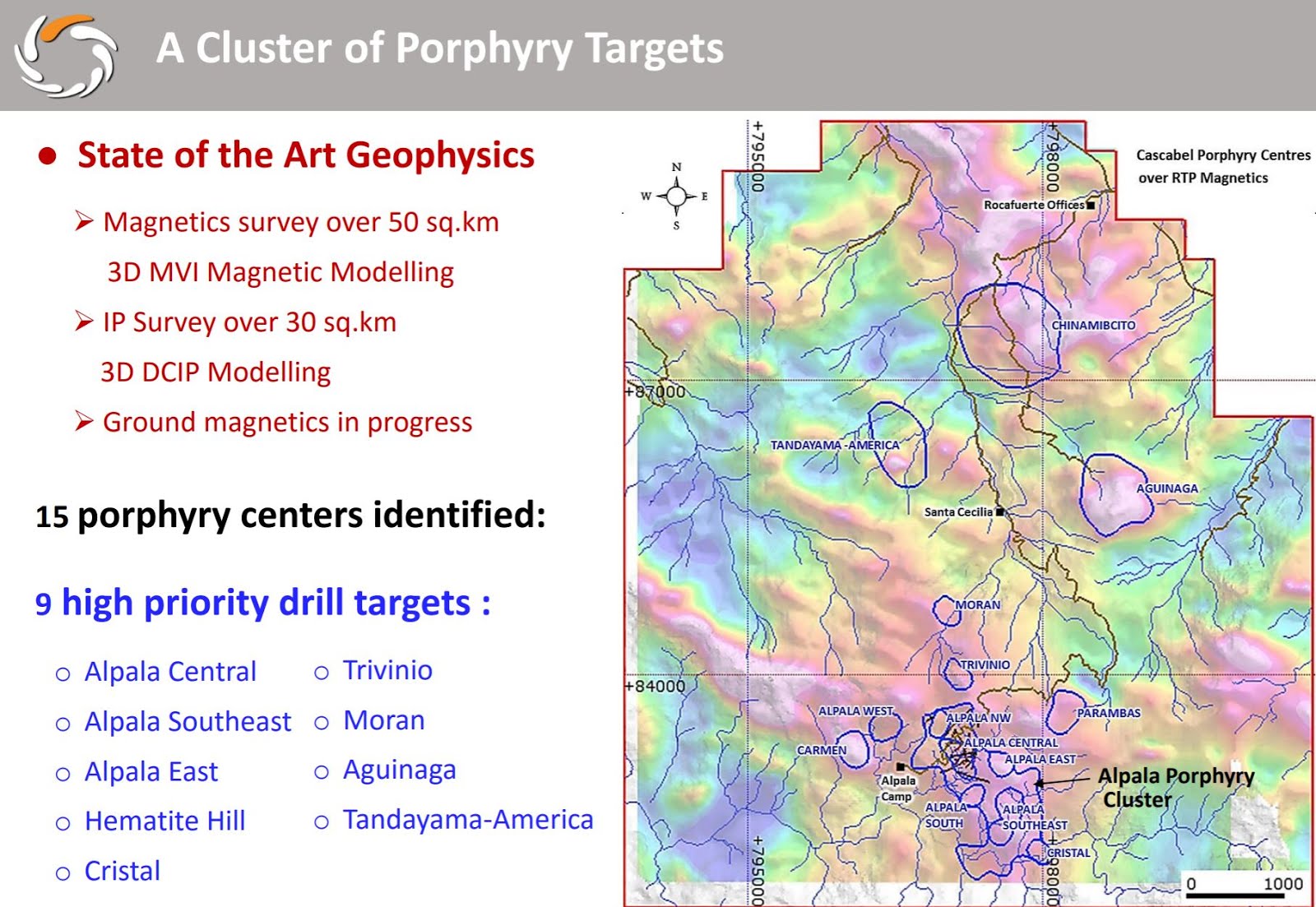
SolGold - Aguinaga - an initial review

DISCLOSURE - I OWN SHARES IN SOLGOLD

At last, some drilling away from Alpala (link)! SolGold have finished the first hole at Aguinaga (link). Unfortunately, I don't think the results will be very special, I'm guessing that they come in around the 0.4-0.6% CuEq level.

This is what we are told about the first hole:

Translation - feck, we hope it gets better at depth

It is very early days (1 hole), but the concern is that the Aguinaga Porphyry appears to be small and low grade. We see that the 'strongly mineralized porphyry' was intersected ~300m vertically below the discover which limits its extent to the NW and being just ~250m wide (horizontally) limits is potential to become huge. Bollocks!


The core photos from hole 01 look a bit anemic. They look similar to the low grade holes at Alpala, that typically ran around 0.5% CuEq (typically 0.3% Cu and 0.1-0.2 g/t Au)


At Alpala, if a drill hole was bulging with copper sulfides, Sol Gold would rush out an early release with partial results. They haven't done the same here, we get some confirmation of lack of optimism in the hole by the company in this statement.


i.e. the core looks crap, we're leaving the rigs to drill the good stuff

However, if we work back we know that the drilling would have passed through the 'well mineralized' porphyry around the start of April, so we should expect the results to be released before the end of the month if they are good enough to stand on their own. If they are below expectations, they'll be buried in a PR with a load of intercepts from Alpala.

I've created a separate Leapfrog project for Aguinaga, you can get the viewer file from here (link)


Tuesday, November 14, 2017

SolGold Update

DISCLOSURE: I own shares in Sol Gold, and before you ask, I'm irritated that they did a financing at GBP0.25p.

Well we are moving into the home straight, we've been promised a maiden resource by the end of the year (link), so it was nice to get some more drill results to have a look at. You can download my 3D model here (link) and open it in Leapfrog Viewer.

Obviously, we are all waiting for the initial resource calculation that was promised by the end of the year. We've only got a couple of weeks before the Christmas party and tax sell-off season starts, so it will be interesting to see if SolGold can deliver.


Summary


  • Infill holes, duplicating and extending to depth known mineralization
  • Is hole CSD-17-028 hinting at a core of a system just to the south (currently being explored by hole 030)?
  • Hole CSD-17-026-D1
    • Similar grades to adjacent hole CSD-14-009
    • high-grade lower zone (from 1150m) looks to be quite consistent
    • upper zone looks to be quite narrow, and may link up with the high-grade zone in hole 14
  • Hole CSD-17-028 - drilled between holes 021 and 022, similar grades and thicknesses

Geology Drivel

Even though these results are groundbreaking, just extending and exploring known zones, they do appear to show that in there could be more than one grade center at Alpala. I also hate that they don't highlight where the holes are located.


I not going to say that there are 2 porphyry centers (I haven't seen the drill-core or any interpretative geological plans for the project), so I've done some doodling on the map that accompanied the PR.

WARNING: Geology doodles by an insane, de-bearded geologist
So I'm quite excited about holes 30 and 30-D1. If they come back with some decent intercepts my stupid idea  alternate interpretation could be correct, it could have a nice positive effect on an undated resource calculation in 2018, as these holes won't have been completed by the time the initial 43-101 resource is published in the next few weeks.

If we look at the holes individually, and again, I only have the data in the press release to work with, so it is incomplete and a best guess.


Hole CSD-17-026-D1


We can see that hole 026-D1 hit a decent zone of material grading >0.7% Au and >0.45 Cu. My feeling on why the Au zone appears thicker is a effect on how the data has been reported, and we would see a >1g/t zone from 1400m to 1550m but it wasn't split out in the PR.


Hole CSD-17-028


Hole CSD-17-028 was drilled between holes CSD-16-021 and 022, so I'm assuming that it was an infill hole to provide more confidence in these intercepts. It returned very similar results to hole 021.


Resources

I've hidden this at the bottom of the post. I'm not 100% (or even 50%) confident in my officially bad resource guesswork for Alpala, but I wanted to include the table to see what numbers I come up with to see how SolGold will get to their:


I regard this statement as a BS, the recent drilling didn't do much to their resources, and I don't know why they are mentioning that they want to define a billion tonnes at 0.9% CuEq at a 0.3% CuEq cutoff. That puts it firmly in the uneconomic category for an underground block-cave.


So according to Macquarie, for a 0.9% CuEq block cave to give an IRR of 15%, it will need to have Cu at >US$3.5/lb and Au >$1750/oz.

Personally, I'll be looking at the size and continuity of the >1% CuEq cutoff resources.


So, I'm not sure that they'll get to their billion tonnes, but I'm convinced that my model is under reporting the narrow-high-grade zones.


Thursday, October 19, 2017

Solgold Leapfrog project

I've received a few e-mails from people asking for the full Leapfrog project for Cascabel.

To open the project you need to have the saltest version of leapfrog Geo. You can download an evaluation copy from here - link

You can download the full Leapfrog project from here - link (145MB)

You can download the source drill-hole and surface contour data from here - link (10.8Mb)

I've also created a Leapfrog View containing all of the data I used - link (29.8Mb)

The viewer file can be open using the FREE Leapfrog Viewer program that can be downloaded from here - link

For anyone interested in Leapfrog, I'm working on compiling the Paca project data (as it has everything) into a training data set.

Thursday, October 12, 2017

Sol Gold Update - dark clouds on the horizon?

DISCLOSURE: I own shares in Sol Gold.

Sorry, I've been a bit snowed under with work, here is a quick update with the new drill holes released by Sol Gold a couple of weeks ago (link) and last week (link).

I've also done a complete rebuild of the model to make sure that it matches SolGold's maps as accurately as possible.

Summary

  1. Lots of grade smearing in latest PR
    • Hole 023R-D1 - 254m @ 1.16% Cu and 1.93 g/t Au, surrounded by material grading less than 1% CuEq
    • Hole 024-D1R - 512.9m @ 0.53% CuEq, in reality is 160.8m @ 1.19% CuEq surrounded by materail grading less than 0.5% CuEq
  2. High-grade (>1% CuEq) mineralization restricted to very narrow zones - SolGold even tell us that these zones are 2-4 times narrower than the reported intervals
  3. Bulk of the rock at Alpala grades <1%CuEq, which is probably uneconomic to mine
  4. I haven't updated my calculations as I don't have sufficient data quality (due to grade smearing) to produce an accurate number.

Background 

Just a quick summary on how the model was created and how the data was extracted, I know this is probably repeating a lot of what you already know, but it is important as it shows how results can be skewed.

All data is from the public domain (i.e. SolGold Press releases and presentations).

This means that I have to estimate hole locations (I georeference the plan maps), direction and dips. They are moderately accurate, but not perfect. there is a lot of guess work to make the hole line up as closely as possible.

The assay data comes from the Press releases, and I run it through Corebox's excellent Drill Hole Interval Calculator tool (link) to back calculate the residual grade of the rocks that surround the high-grade intervals. This is done to see how much of the grade is in that narrow high-grade zone, and if the surrounding rocks actually contain enough metals to be mined.

You can download the latest 3D viewer file from here (link), but you'll need to download the latest Leapfrog Viewer program to be able to open it.

When you look at the press releases for the Apala drilling you need to be thinking the following:

  1. How are the results being presented in the best way possible
  2. How will the deposit be mined

To be logical, let us start with point 2 - how are they going to get the crap out of the ground?

Here is a section through Alpala.


Decent mineralization starts at ~700m below surface, so if it gets mined, they will be doing it from underground. If used several images from a report written by Macquarie Research on Block caving (link).

Large scale underground mines have several 'unique characteristics'
  • They require a higher CAPEX than a similar sized open pit operation
  • Have higher operating costs
  • They take longer to develop and ramp up to full production
    • 5 years of underground development
    • 5-7 years to ramp up periods
As a result, they are much more sensitive to changes in metal prices and Capex. However, they can have better returns on invested capital compared to open pits.

However, Alpala is an exploration stage project, we don;t need to get bogged down by all that engineering crap. However, their repot had this figure.


Think of this as a reference diagram, plot on where Alpala should sit along the red lines.

Which line do you choose? Well, look at the assay tables in any of the press releases and you see how SolGold have calculated their CuEq grades


So, draw a line on it for US$1300/oz for Gold and $3/lb for copper, and then a horizontal line back to the Y-axis (CuEq%) to see what grade Macquarie think you need for a viable underground block-cave greenfield project like Alpala.

Here is my version:


So ~1.5% CuEq for Alpala to be a standalone, viable project.

Point 1: The results 

Why don't we now look at the assay table from the latest PR, reporting the mineralized intervals from holes 023R-D1 and 024-D1R.


At first glance, everything looks awesome. Hundreds of meters of decent grade material. I mean EVERYTHING in hole 23R-D1 is ore, hole 024-D1R is less good....

However, there are some clues that not all is as rosy as being presented.


Why are they giving intervals at different cut-off grades?
To me, this mean that that they a narrow very high-grade zone surrounded by low grade crap.

Why don't we back-calculate the residual grade

Hole 023R-D1


They have decent stuff from 958m to 1212m, but the rest is crap.

Hole 024-D1R


Same story here, but then again, they drilled the same zone hit by hole 024

For these 2 holes, only a very small portion (36% for hole 023R-D1, and none of hole 024-D1R are good enough for an underground mine. Most of what they drilled in these 2 holes is mineralized waste.

They even tell us that the mineralization is narrow in the text below the table. it says: 


This means that SolGold's geologist believe that the true with of the intercepts are 2-4 times narrower than the interval length reported in the table, so:
  • 745.1m @ 1.29% CuEq mean that the true width of mineralization is between 186.3 to 372.55m wide.
How does this compare to the rest of the drilling? Do we see similar narrow, very high-grade zones surrounded by mineralized waste?


Very hard to see on the plan map in the press release, but fortunately with the power of Photoshop, we can lighten this image. I've chucked on my interpretations for fun.


The most consistent mineralization is around holes

Here is a zoomed in part of holes 15, 16 and 23 which is where holes 29, 29D1 are all heading, but that zone only has a 200m x 150m horizontal extents. The rest of the high-grade is quite scattered and look to be dikes.

horizontal distance between the 2 lines = 35m


We can see the individual assays, they are a bit blurry as I've zoomed in really close, but you can see the individual assays and you can see how quickly the grade drops off around the high-grade samples.

Look at the plan map, how when you look closely, most of the >1% CuEq mineralization is restricted to narrow zones, that are hard to join together. there doesn't appear to be a solid, high-grade core, just a lot of narrow high-grade dykes surrounded by mineralization that would be marginal if exposed at surface, but at >500m depths, it will never be touched.

I'm a bit disappointed, and gut feel is that the actual resource will be significantly lower than what the market expects, as these high-grade zones aren't consistent and don;t appear to join up.

However, I invested in SolGold for the other targets, I knew that Alpala was deep and probably not good enough as a standalone deposit. I want to see them drill somewhere else.

If you want the full Leapfrog project - e-mail me at theangrygeologist@gmail.com and I'll upload it for you


Thursday, August 17, 2017

Solgold 43-101 distillation

DISCLOSURE: I own shares in SolGold

I promised to review the technical report on Cascabel, so here it is. I apologize that it took some time, I've been withoutt internet for a weeks

Simply put, this report is a qualifying report for SolGold's listing on the TSX and a setting the foundation for the initial resource estimation that we are promised to receive in December (link).

SRK are checking that the project exists, the drilling and sampling have been done to best practices, and that there are no major technical issues. It also outlines historic exploration and proposes some future work programs.

Summary

  • Nothing groundbreaking, but a lot of useful info
  • Good geology
    • big regional structures = good plumbing
    • big Batholiths = good potential Cu source rocks
    • Some good neighbors (a good indication of potential in the area)
  • Data collected is high quality with no issues
    • early Met test in 2014 show good recoveries
    • SRK mention minimal deleterious elements
  • Exploration potential
    • Alpala and Aguinaga are the best prospects, and received the most attention
    • NW prospects appear to represent the tops of deeply buried systems

There is a lot of text, so you don't have to read on!

Section 1 - The introduction tells us what SRK did and didn't do, what data sources they used and the scope of work. It was interesting that the report was completed in February 2017.

Section 3 - this tells us where the project is located, but also some background on the mining and environmental laws in Ecuador, as well as the holding costs, any underlying agreements, and the tax regime (page 19) if the project gets developed.
  • Income Tax = 22%
  • Labor Profit Sharing tax = 15% (12% to the state and 3% to employees) for a large scale mine
  • VAT= 14%
  • Municipal taxes, social security
  • Royalties = 8% on Copper, Silver and Gold
  • Windfall tax = 70% of the gross obtained from the sale of mineral at a higher price than the base price established in the Mining Exploitation contract
The windfall tax is interesting and I'll need to research a bit more to see what it fully means, does it mean that if the base price for Au and Cu is set at $1300/oz and $3/lb, the mine will have to pay 70% of the gross revenue received over that amount, so this means that once a project moves towards production, there has to be careful negotiation to set this price as high as possible so you have a lot of wiggle room?

Section 4: this tells you if access to the project good or bad (big impact on exploration costs if everything has to be helicopter supported) and how far away are power (for the mine) and transport links (to ship out the concentrate to the port).

This is useful to check so that if the project gets developed that the operator won't need to spend a large amount of money on a power plant, port, concentrate pipeline etc. that can add a lot of bucks to a project's CAPEX, basically look for some black clouds on the horizon.

At the moment, everything seems OK, there is a rail link just north of the property that runs to a port (they may need to check capacity as when (if?) Codelco's mine gets going, it may use it all up).

There is also a small section on climate and physiography. this will have an impact on construction costs (can they use the morphology to fit in the dumps and surface facilities or do they have to flatten hit tops etc.)

Section 6:  This is the key section is we want to determine the potential at Cascabel.

We want to see:
  • Plumbing: A big regional structure running through/close to the project (the Cauchi-Pujili Fault Zone)
  • Potential: Are there any other big deposits in the area
  • Mineralization Source: Some big batholiths (the red and pink blobs in the map below)

We can see that Cascabel has all three, but we need to remember that not all porphyries, in this area will be  mineralized!

Local Geology - it is always good to have a quick look at the rocks exposed in a project, as they can have a significant impact on mineralization:
  • Limestones - potential to form high grade skarns (think Antamina, Las Bambas etc.)
  • Andesites - contain Iron that can be used to precipitate copper (chalcopytite is an FeCu sulfide) minerals.
I also like Figure 6-6, it is a good overview on how you can use soil geochemistry to define exploration targets. Copper porphyries, like any deposits have a well defined geochemical signature (this varies by exposure level and host rock that can shrink or expand these anomalies).


You may ask why there is no copper map. This is because it is easily leached from soil and we are in a tropical environment. 

The Mo is much more stable and will generally remain insitu.

The Manganese and zinc are exhaust metals, they require lower temperature and pressures to be precipitated and are found much further from the porphyry. We can see that where are some nice strong Mn depletion zones at Alpala and Aguinaga, which is again a good indication of where the poprhyries are located.

The Cu/Zn ratio is very useful as it highlighting any weak copper anomalies in the core of the system.

You can also use the geochemical signature to check the exposure level, it looks like Americas, Chinamibcito have smaller, more subtle signatures, and this may represent more deeply buried porphyry systems (drilling will have to tell us how deep they are).

Mineralization
There is a lot of geobabble here, however, figure 6-9 is the most interesting


A load a wank I know, but it tells us that the copper is introduced by B-veins, which is what they have found at surface at Aguinaga just a 1000m closer to surface.

Alteration - just some geowank, it is interesting to geologists and can be useful to vector towards the core of a system, what is important is the size of the alteration system, simply put:
  • big alteration = big system
This doesn't mean that the porphyry will be mineralized, but increases the potential.

We'll ignore the bar plots, the scatter plots show that Cu and Au generally occur together (no surprise there).

Structural geology
this is interesting, this shows the potential targets, but a big about porphyries. Simply put, porphyries are formed when batholiths cool and incompatible elements (i.e. Cu and Au) are 'released' by their host minerals. These incompatible elements go into a mush/liquid that rises and pools in highs (technical term is apophyse) in the batholith roof.


These highs are often formed in zones of weaknesses, i.e. where multiple structures intersect and break up the rocks, for example:


So we see that we have multiple zones of weakness where the three structures intersect that see to correspond to Alpala deposit and the other exploration targets.

So we have good plumbing, with Alpala we know we have a source that was rich in Cu and Au.

I just want to include a brief message about geophysics, you often see a large chargeability anomaly surrounding a porphyry as it is detecting the pyrite halo which is generally unmineralized.

It irritates me that so many junior exploration companies insist on drilling the red blob and don't drill the changeability low in the middle. The reason for this is that the halo can contain >5% Pyrite whereas the core may contain 2-3% Chalcopyrite and therefore appear to be a (relative) low.

We also get a nice section (6.3.4) talking about the otehr prospects, and we basically see that there isn't much as most exploration activities have focused on Alpala and Aguinaga. These can all be put in the 'needs more work' category. they all have similar 'features' to Alpala, but their potential is unknown until a truth machine (drill-rig) arrives and puts a few holes into them.

SolGold have focused on the 'best' targets and haven't been very distracted by the regional prospects.

Section 8 - exploration.
This gives us a run down on what SolGold have done on the project. this is fairly standard, but if you have invested in another porphyry exploration company, check to see if they are doing the same.

I like the fact that they have done proper channel samples with a saw so that they are unbiased. This is good, it means that these samples could be used in a resource estimate as they are essentially horizontal drill-holes.

Section 9 - drilling
For me, I'm going to steal the hole coordinates to rebuild my model, but what you want to check is that:
  • Have they surveyed the collars properly (DGPS or professional surveyor) as handheld GPS can give errors of up to 20m, or worse in steep or forested terrain
  • Have they done a proper down-hole survey (gyro is best, followed by EZ-shot and if they are using a tripari or acid bottle, or not surveying - run away)
  • is the recovery good - 97% is excellent, there is probably slight loss at the start of the hole (you wash away some soil) and in fault zones. If you see less than 80%, be concerned.
  • Orientated core - is a nice bonus it helps measure vein, contact and the orientation of structures.
  • Are they storing the core (think Bre-X), and where are they storing it
    • at site means they have to build warehouses
    • off-site - they are renting warehouses
Section 10: Sample prep
This is where we can see how the data is being collected and if Solgold are meeting (or exceeding) standard practises.

I like the fact that they are collecting Specific Gravity measurements as they drill (1 per core tray), as when the project evolves this will be very useful to accurately calculate the destiny of the rock and mean that the tonnage calculated will be precise.

Sample selection - this tells us that they are sampling everything (mineralization at ~2m widths, waste at 6m widths). This costs money, but will allow them to create a detailed alteration and mineralization model that could help to vector their drilling on other targets. Most companies don't do this (as it is expensive).

Section 11. QAQC
This is to show that the data they are receiving from their assays is any good. We can see that early in the project, when they were using Acme labs, the data was poor, so they changed to ALS and then Met-solve that have produce much higher quality samples.


We also see some minor issues with the blank standard, this seems to be picking up some calibration errors in the analytical equipment (it is typical that there is 'drift' that means the machine needs to be calibrated frequently).


One question I did have was regarding the low quality results from Acme (almost 60% of the analyses) but SolGold have sent a load of samples to Metsolver to verify the Acme data and it appears that the results are comparible.


Section 12 - Met study
Wow, an early metallurgical test, this is a very pleasant surprise. Solgold are checking to see if there could be any issues with recovery, way back before they started to spend big bucks on drilling. This is an early test just to check that the gold and copper can be recovered by standard methods and they good some good results:
  • 86.5% recovery for Cu
  • and ~80% for Au
Not brilliant (Cu recoveries in a typical porphyry should be >90%), but it is a start. 


Section 22 - Adjacent properties
This shows who their neighbors are, and potential players in the area. Why isn't the area to the north staked? Is there a national park there?

It is also important to see how close the deposits are to the property boundary. Fortunately, here both are well within, so there is no need to deal with greedy neighbors.

Tuesday, July 18, 2017

Solgold technical report

A 43-101 report has appeared on Sedar for Solgold's Cascabel Project (link).

You can also download it from here (link).

I'm going to spend the next few days going through it and get back to you with some comments


Monday, July 3, 2017

Hole 23

DISCLOSURE: I own shares in Sol Gold.


Question: What is the easiest way to find a million ounces of gold!

Answer: Drill a hole through the guts of a high-grade copper-gold porphyry

Each of those squares measures 300m
Here is hole 23R from Alpala (link). It went straight through the core of the Alpala deposit. There is a lot of grade smearing going on. In reality they only drilled 474m of economic mineralization (>0.5% Cu and 0.5 g/t Au), with a spectacular high-grade heart grading >1% Cu and ~3 g/t Au.

Here are the updated official bad resources:

A nice jump-up in contained metal!
Alpala will be an underground operation, and here is an excellent summary on costs involved for block cave operations - link. Here are some comparative sizes of some of these projects:
  • Cadia: 1.5BT @ 0.47 g/t Au, 0.27% Cu
  • Hudo Dummit: 500Mt @ 1.66% Cu, 0.35 g/t Au
  • Resolution: 1.8Bt @ 1.54% Cu
Brown = brownfield projects; green = greenfield projects
When we look at the project listed in the figure above we can see that there are 2 types of projects:

Brownfield

  • Satellite, high grade deposits next to an active open-pit mine
  • Depth extension of ore-bodies that were mined by an open-pit but now is too deep to be mined from an open-pit

Greenfield

  • standalone development projects
The reason I highlight this is that the cost to developing a brownfield deposit next to an active open pit mine or going underground to mine the deeper part of the same deposit a lot cheaper than building a new mine one from scratch. This also means that brownfield projects don't need to be as large or as high-grade to be developed.

At the moment, Alpala isn't quite big enough or high-grade to be a stand-alone operation, a few more holes like 23R will help! However, this is where the other exploration targets come in.

From Sol Gold June presentation
At the moment, all drilling has focused on Alpala, let us have a look at Aguinaga.

the hair nicely outlines the Cu mineralization found in a porphyry
We are told that they plan to start drilling there later this year. From Surface mapping and sampling they found some nice juicy rocks at surface, that look very similar to what they have been drilling at depth at Alpala.


Here is Aguinaga and Alpala. What Sol Gold are drilling at depth appears to exist at surface at Aguinaga.


Imagine what would happen if they found another Alpala at Aguinaga?


Wednesday, June 28, 2017

Cascabel - Latest Results

We got results from 2 more drill-holes from Alpala last week (link).

I've plugged the numbers in and this is what it has done to my officially bad (tm) contained metal calculations.

Copper


We have a 14% increase in tonnes and an equivalent increase in contained copper

Gold


Here we have a 10% increase in tonnes and 8% increase in contained gold, so a minor (1%) decrease in grade.

This is some very unfashionable results, normally companies like to drill huge amounts of low grade and amaze everyone with the total contained ounces of gold and tonnes of copper.

So where did these results come from?

Starting to look quite big
Hole 25 was drilled 200m to the SE of hole 19, and below historic hole 13-003 that terminated before it hit the main zone Cu-Au mineralization. It hit a 100m zone of high-grade mineralization from 772-872m but quickly passed into low-grade/marginal material.

It suggests that there could be better mineralization to the NE, maybe an additional hole could be drilled from same platform to the NE?


Hole 24 was disappointing, it was drilled 500m to the SE, and hit a narrow (~50m true width) interval grading 0.65 g/t Au and 0.63% Cu, surrounded by very low (<0.2% CuEq) grade mineralization. It looks like hole 24 just clipped the very edge of Alpala mineralization.


You can get the LF viewer file from here (link).


Tuesday, May 2, 2017

Solgold - update

DISCLOSURE - I own shares in Sol Gold. I'll try to make this post unbiased, but I want everyone to buy lots of shares so that I can make some money!

We got some news a couple of weeks ago that gave us the final results for hole 21 and a PR today with some visual results from hole 23R, 24 and 25.


Hole 23 was drilled right through the middle of Alpala and will get some great results. Holes 24 and 25 were drilled to test the SE continuation of the Alpala system. They hit ever decreasing thicknesses of gradually lower grade mineralization, which is what you would expect as you move away from the core of the system.

Here are the updated official bad estimates


  • Copper increased to 1.9Mt
  • Gold increased to 4.95Moz 
Looking good, but we see that there is a smaller increase in high grade (>0.6% Cu and 0.5 g/t Au), which is the material that will be mined via and underground block-cave operation.

My prediction:

  • Hole 21 - 925m @ 0.5% Cu, including a 400m >0.6% Cu - hole only 100m from hole 16, which hit a lot of good stuff
  • Hole 23 - being drilled, target between holes 16 and 19, so I'll expect
    • 200m >1% Cu and 1 g/t Au (@ 1,000m depth), within a 1000m zone of 0.3-4% Cu and 0.2-0.4 g/t Au

Actual

Hole 21
  • 844m @ 0.73% Cu and 0.43 g/t Au
    • inc. 670m @ 0.82% Cu and 0.51 g/t Au
    • inc. 304m @ 0.99% Cu and 0.63 g/t Au
So, I was a bit-off, sort of like my high-school review - has talent, just needs to work harder.

Hole 23 

  • 573.2m of sulfides from 563.7m depth
    • at >1.4% volume percent chalcopyrite
    • or a guesstimate grade of 0.48% Cu
  • a higher grade zone from 979.2m to the current EOH at 1136.9m
    • at >2.9 vol-percet Chalcopyrite
    • or a guesstimate grade of 1% Cu
Hole 24 - 248m @ >1.1 volume percent chalcopyrite or 0.38% estimated copper

Hole 25 - 454.2m @ >1.5 volume percent chalcopyrite or 0.52% estimated copper

I calculated the guesstimate grades by taking the volume percent of chalcopyrite and multiplying it by the copper content of chalcopyrite

so 1.4 * 0.346 = 0.48% Cu

However, it is very hard to accurately measure the grade visually, so we can use these as guide to where copper is present or absent.

NOTE: I haven't used the estimated copper grade in the tonnage calculations.

Here is the updated leapfrog model (link)

Geology

It is hard to gauge the importance of hole 24 as it is still being drilled, but from the information we're given:

  • Hit a narrow low-grade copper zone 400m away from other mineralized drill-hole
  • 248m @ 1.1 volume percent chalcopyrite or 0.38% Cu from ~740m depth.
porphyry getting thinner to the right (SE)
We can also see that hole 25 (454m @ 0.52% Cu) is also a step down from the high-grades hit in hole 21 in the core of the system. This indicates that we are moving away from the high grade core into the lower grade periphery. 

This is normal in porphyry systems - you have the thickest, highest grade mineralization in the core of the system and lower grade at the edges.

Drill-hole 23 was drilled smack into the middle of the high-grade core, so this will get some decent mineralization, but won't have a huge impact on tonnes (see section below). I will expect it to hit good copper grades until around 1300m depth. I'm going to upgrade my guesstimate to:
  • high grade (>0.8% Cu) from 980m to 1350m
Hole 23 - drilled straight through the guts of Alpala.