Saturday, January 28, 2017

SolGold - Casabel Update

DISCLOSURE - I own shares in SolGold as I think it is one of the best porphyry projects currently being explored.

We have been receiving some news from SolGold about how drilling is progressing at Cascabel (link and link).

Summary


  • No surprises, the holes announced (18, 19 and 20R) hit copper mineralization where expected
  • Hole 18 is an infill hole = will return great grades but won't add many tonnes
  • Hole 19 and 20 are very conservative, with minor (50-75m) step outs from earlier decent grade holes
    • they appear to show that the porphyry is quite narrow (~250m wide)
I was disappointed that Sol Gold wasn't going to be a but more adventurous with their drilling and have one of the 3 rigs drilling a bit further away (e.g. around Alpala SE) to test the upside at Alpala - is it a series of medium sized porphyries or 1 enormous one.

Maybe next time...

Here are my officially bad (tm) resource calculations


So that isn't too bad, it will be interesting how these results compare to the official numbers.

You can download my 3D model and resource calculation spreadsheet from here (link), and you can e-mail me if you want the complete project.

Section 1 - Hole 18


Black bars = where DH have intersected copper mineralization in SolGold PRs
We can see that hole 018 is only 50m away from hole CSD-14-008 and CSD-15-014. We can then predict what it will intersect my predictions are:

  •  0.5% Cu and 0.5 g/t Au from 1000 to 1450m
    • including ~0.8-1% Cu and >1 g/t Au from 1050 to 1250m

Section 2 - holes 19 and 20R

Red line - approx. extents of porphyry mineralization
We can see that holes 19 and 20 are again minor step outs from earlier high-grade holes, and hole 19 hit mineralization where expected (i.e. at the same point where hole CS-16-017 hit mineralization), as did hole 20R. No surprises here. My prediction for hole 19 is:
  • 0.5% Cu and 0.6 g/t Au from 325.6 to 1161.5m
    • including ~0.6-0.8% Cu and ~1 g/t Au from 850 to 1161.5m
    • 325.6 to 850 will run around 0.4% Cu and 0.35 g/t Au
For hole 20 I'm not going to predict grades, but I think that Cu-Au mineralization will be intersected from 905.4 to 1450m, where it will pass very close to (less than 50m) hole CSD-16-016 that hit a nice high grade zone from 934-1301m that graded 1.34 g/t Au and 1.01 % Cu.


One downside is that the porphyry appears to be quite narrow (only 250-300m) wide, the best mineralization is very deep (750m depth).


Friday, January 20, 2017

Bulk Density - an overlooked part of a resource calculation

I touched on this as part of my series of posts on the Hermosa project, and I wanted to expand.

Tonnes = volume x bulk density

Companies spend a lot of time calculating the grade and the volume, but as we saw with Taylor deposit there have been a few cock-ups cause by not getting the actually density of the different rock that contains the metals you want.

Bulk Density is also specific gravity - this is the mass of a rock within a certain volume and is normally expressed as grams per cubic centimeter or tonnes per cubic meter.

For reference water has an SG of 1 which means:

  • 1 cm3 of water weights 1 gram, 
  • 1 m3 of water weights 1,000,000 grams or 1 tonne.

SG of different rocks - link
SG of different sulfide minerals - link

The SG value for a rock if affected by porosity (microscopic spaces between the grains), fracturing (faulting), weathering (removing minerals or altering them into 'lighter' clay minerals).

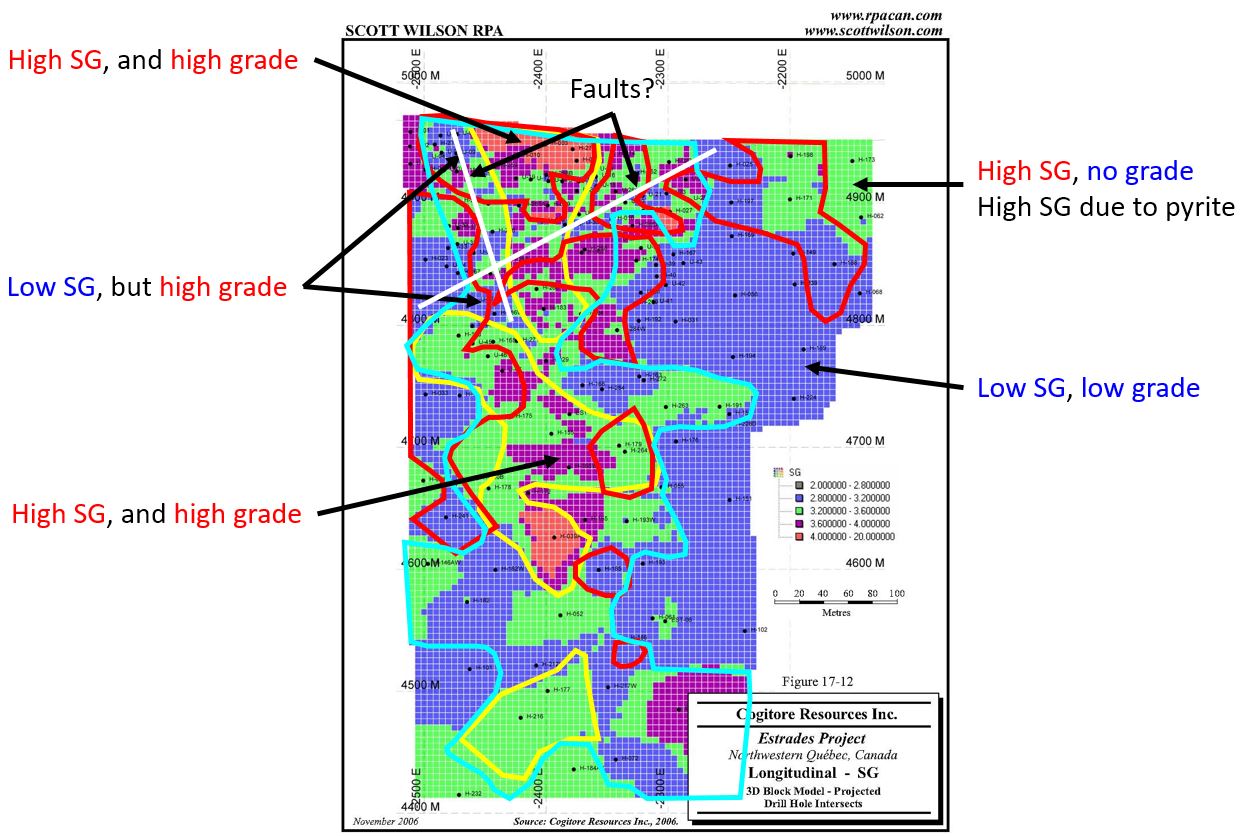
Why is this an issue? Here are a series of long sections from Galway's Estrades project in Canada. These images came from the November 2006 Technical reported prepared by Scott Wilson RPA for Cogitore Resources Inc.

Here are a series of long sections showing the distribution of each major economic element (there are sections for gold and silver but they constitute a very small part of the rock and won't impact the bulk destiny by any significant amount).

Zinc

Copper
Lead

Bulk Density
Here is an annotated version where I have drawn on (badly) the >1% Pb, Zn and Cu grade contours.


You can see that in general there is a reasonable correlation between grade (total sulfide content) and SG, but it isn't perfect. We can see that the Bulk Density (SG) varies from less than 2 g/cm3 (blue) >4 g/cm3 (a 100% difference). So you can see the problems that could be caused if you use a single bulk density value for a rock type or ore zone, or use an arbitrary values. 

Most companies have adopted the "take lots of samples" approach as collected bulk density measurements is cheap and quick and will allow you to accurately model the changes in the bulk density within a deposit.

However, if you see a company using single or average bulk density values (or mathematical formulas) in their resource calculations, it should make you stop and think for a moment as there have been some major and costly failures where companies haven't used the correct SG value.

One interesting technical question to ask - specifically directed towards Hermosa - is what is the correlation between sulfur assays and bulk density?


Friday, January 13, 2017

Hermosa - a summary

We seen over the past week a series of posts on Arizona Mining's Hermosa Taylor deposit that it has issues, and I apologies for being negative on this project but we are talking about a company that has market cap of ~$600M. They have sufficient funds to everything to the highest standards. For me, the most frustrating part is that they appear to have been careless (the manganese issue) and dishonest by 'erasing' references to 'clean' concentrates and decreasing recoveries and concentrate grades.

If I was a shareholder, I would feel that I was entitled to a honest reply from the company. Instead AZ management have gone into "ostrich" mode and buried their heads in the sand.

Manganese

The manganese question could tacked head-on. All they have to do is go back to the assay database and check see if the manganese is pervasive or just found in a few areas (i.e. close to the manto oxide zone). This would take a couple of days to do, and would have allowed them to state that the manganese was a local issue and by accident some of the samples used for preliminary metallurgical sample contained significantly more manganese than the majority of the deposit.

However, AZ management decided to take the mature approach. They removed the following statement from their latest presentation, but you can still find it in their Jan 7th 2016 PR (link).

Dec 7th Presentation - slide 6
and in the technical report

Page 6 - Oct 2016 Technical report - this statement is repeated on pages 7 and  94

I wonder if we will see an amended technical report with an 'updated' metallurgical section in the coming weeks?

Metallurgical Recoveries and concentrate Grades

I'm extremely concerned about the changes to the metallurgical recoveries and concentrate grades values in the recent presentations. They match the values in the technical report, so why where incorrect values used in the December 7th presentation?

The timing was a bit strange as the date of the presentation coincides accidentally with the announcement that they had raised $36M to develop the project (link)?

My concern is that maybe this was another careless mistake, like the manganese issue, and bulk density question. However, when you look at it, that is a lot of faux pas from a single company.


The Elephant in the room

I apologize for sounding negative, AZ have defined a lot of resources and control ~17,500 acres of prime exploration ground. They've done a lot of drilling, so why don't we have a look at where those holes are:

DO NOT CROSS THE RED LINES
Wow, all of the drill-holes are on private land? OK, I get it, permitting is much easier on private land, but AZ have been drilling Hermosa since July 2007 (funny fact - it took them 7 months to release the results (link*)), surely in that time they would have got a permit of two to allow them to drill in the lava public land surround the deposits?

I like the way (circled in yellow) they've had to drill these weird orientated holes, like tentacles of a perverted squid in a Hentai cartoon reaching out for a nubile young lass.

*press releases prior to this (link and link) were releasing assay results from the re-sampling of the historic ASARCO drill sample pulps. 

The question you have to ask is:

Why? It is reallly that hard to get a permit to drill a few holes in the Coronado National Forest?

If you can't get a drill permit, imaging the issues that they will face when they try and develop the project? I'm sure it will be easy, just like at Resolution (link, link or link)!

Well, at least they will have got someone on-board to buy the concentrate, but then again the observations from Ocean Partners are just words. they mean nothing as we have to be realistic here, there is going to be no mining, and no concentrates being produced from Hermosa in the next 10 years.

up to 6 years just for the permits
and some fecking nimbys


Heck, if they want, I'll sign an MOU to discuss the precious metal stream....


Thursday, January 12, 2017

Hermosa - January Update

AZ released some spiffy new drill-results today (link)


When you look at the accompanying plan map, you can see why the results from hole 396 were good, and the other holes didn't really hit much, just a few narrow zone and veins, so we'll ignore them.

high grade zone circled in red
When we zoom in, we can actually see that hole 396 wasn't a huge intercept of medium grade mineralization but a series of narrower high grade (>10%) zones within a large zone grading between 2.5-5% Zinc.

Red >10% Zinc; Blue 2.5-5% Zinc
Hole 396 was drilled to follow-up on the thick intercepts in holes 333, 334, 335 and 374. When you step back you can see that there are a couple of areas where the mineralization is much thicker than everywhere else.

Central zone centered on hole 333, 334 and 396; second zone centered on hole 104
You can see that there are 2 distinct orientations to the zinc mineralization:
  1. Predominant - A series of sub-horizontal (dipping down to the left or northwest) zone related to rock contacts and the basal low angle fault.
  2. Vertical pipes (?) of base metal mineralization - most likely related to vertical faults being used as conduits for mineralized fluids.
This is important as for accurately calculating the resources you need to model each zone separately, with their own bias to the direction (search ellipse) that the mineralized intercepts are joined together to link adjacent drill-holes. This is important for fault hosted mineralization (the vertical stuff) as the fault zone could be very narrow (a few tens of meters) and very high grade.

Check out the copper distribution:


The copper appears to show a bit of zonation. the deeper mineralized horizon is much richer than the upper Zinc horizons, except where you see those nice thick intercepts, is that telling us something? You would expect to see elevated copper in the hotter parts of the system, deeper or nearer the source intrusive, but also where you get zones of weaknesses where fluids will be focused.

In Summary, a good hole, but not an unexpected one. I'll be guessing that we'll be seeing a lot more holes being drilling into this zone over the coming months.

If you want, you can download the 3D model from here (link).


Tuesday, January 10, 2017

Almadex - El Cobre

We got some more drill results from El Cobre last week, and I've decided to use this project as the first to do an officially crap (tm) TAG resource guesstimate.

Summary


  • Small and low grade
    • ~101Ktonnes copper @ 0.19% Cu
    • ~640Koz gold @ 0.43 g/t Au

Let us quickly compare the market caps of a few favorite copper-gold exploration companies:

  • Almadex = CND$70.7M
  • Cordoba = CND$48.92
  • Regulus resources = CND$75.58
Regulus and Cordoba have decent project projects with resources:
  • Alacran = 53.5 Mt at 0.7% Cu and 0.37 g/t Au
  • Anta Kori = 290Mt @ 0.48% Cu and 0.36 g/t Au
The assays from the drilling at El Cobre just show that they have a few moderately wide, average grade zones surrounded by low grade dirt. I thought that I was missing something. So I brought everything into Leapfrog Geo to see how much gold and copper there is.


WARNING

These numbers could cause shock, amazement and cardiac arrest. Please sit down, breathe slowly before calling your broker...


Well, that is deeply unimpressive, but not unexpected.

In general the 'massive' intercepts were nothing special. So here is the latest 3D model (including holes 16 and 17) and the spiffy spreadsheet from here (link), so you can play with the numbers and call me a retard.

So,  Almadex is expensive, Regulus is cheap.

Background rubbish

This is a global 'resource' from all three mineralized areas (Norte, Porvenir and Encinal zones), and I used the 'split assay' data which back calculated the residual grade (i.e. outside of the narrower high grade intervals), to try an give a more accurate value.


Grades are also composited over 5m intervals.

Gold


Copper


I used the following attributes to calculate the resources. the important one for non-technical people is the base range (circled) - 200 - which basically means that Leapfrog Geo uses a 200m search radius to connect the grade shells, which, for a porphyry system, is a good approximation for inferred resources.

I also used a specific gravity of 2.7 tonnes/m3.

If you want the complete LF Geo project - flip me an e-mail (theangrygeologist@gmail.com) and I sent it to you.

Monday, January 9, 2017

Hermosa - more parlor tricks


I don't know how I missed it, we can also see that not just has the recoveries decreased, but the grade of the concentrate has also had a bit of a haircut:
  • Lead - original = 79%, new and improved = 75% - a 4% difference
  • Zinc - original = 57%, new and improved = 56% - a 1% difference
If you didn't know, just to explain Arizona mining insist on using imperial units (which are fecking retarded) so their resource is in short tons not metric Tonnes.

  • 1 ton = 2000 lbs or 907.18kg
  • 1 tonne = 1000kg or 2204.6 lbs

So, if they were reporting their resource in metric tonnes it would be:

  • Indicated = 28.25 million, beautiful metric tonnes
  • Inferred = 75.07 million metric tonnes
A bit different, and I apologize for not seeing it sooner.


Friday, January 6, 2017

Hermosa - a sleight of hand

When you have a project that is suffering from a bit of turbulence, what do you do?

Easy - just remove any misleading statements from your presentation.

We're going to look at AZ's presentations on the Taylor deposit from the 7th December (link) and the 22nd December (link).


  • Great concentrate comments - gone (it makes for a less cluttered slide)
  • we now have different recoveries for Zinc and Silver


Slide 3 - original


Slide 3 - new and improved presentation

they still have the highly experienced management team
We also have different recoveries now

Slide 6 - original


Slide 14 - new and improved

oh no, the concentrate isn't clean anymore!


So in 2 week the recoveries have changed from:

Zinc Concentrate

  • Zn - original = 87%, new and improved = 85.5% - a 1.5% difference
  • Ag - 8-15% original, average ~12%, new and improved = 15%, a 3% difference 
Lead Concentrate
  • Pb - original 93%; new and improved = 92.9% recovery, no real difference
  • Ag - 76-85% recovery of silver, average ~80%; new and improved = 76%, a 4% difference
That is impressive, in 2 weeks with no additional testing AZ have managed to decrease recoveries of Zinc and Silver. Were the values in the earlier presentation wrong?