Showing posts with label Skarn. Show all posts

Friday, February 1, 2019

Sun Metals - Stardust in Central BC

There are very few 'new' discoveries being made, and most junior explorers are flogging dead dogs that have been around for such a long time that most you can ignore.

This was my initial opinion of Sun Metal's Stardust project, it had a tiny resource but has had a lot of work done on it, ~398 RC and diamond holes, or ~70Km of drilling.

Not much here


What a POS - a small, low-grade, well explored project in the middle of nowhere. The didn't seem to be much potential in the existing resources. They appeared to consist of a series of narrow, variable grade zones that have had the crap drilled out of them. 

lots of narrow zones

So where were Sun Metal's going to find more mineralization? Projects like Stardust are quite common for it to go any further, you want to see some potential that it could host resources around >10Mt @ >3% CuEq to get a mid-tier miner (e.g. Crapstone) involved.

I'm just focusing on the skarn mineralization. I know that the project has several other mineralization styles, but they aren't the focus on the technical report, which suggests that they aren't important economically. You can get the 3D model from here (link), there was only a small proportion of the historic data that I could get in.


For those getting massive erections from the Porphyry zone, it has been drilled and no results are mentioned in the technical report, so I assume that it is unmineralized, but the lack of mineralization in it could be:

  • Negative (the majority of intrusive rocks) the magma that formed the stock was relatively metal poor, and therefore any mineralization associated with it will be small and uneconomic.
  • Positive (e.g. Santa Eulalia, Mexico; Taylor, Arizona, Las Bambas, Peru to name a few) – the stock was emplaced into a reactive rock (the limestones) that 'sucked' out all of the metals to form large skarn/CRD bodies leaving the behind an unmineralized porphyry.
However, the recent drilling (link and link) did look interesting. I wanted to check that they were doing more than confirmation drilling, i.e. twinning good old holes to con people into believing that they had found something new.


Simply put, they did a bit of both. Tested the known zones (probably because the historic core is missing), and they tested a few geophysical targets.

The good news that came out in October was from a confirmation hole (i.e. one that was drilled into an area that had been drilled before), and we got this section.


We can clearly see that the majority of the skarns are hosted in narrow limestone units within the phyllite package, which explains the narrow, irregular nature of the resources, which is not a good situation if you want to find a big deposit!


However, drill-hole 18SD-421 was good, it drilled through the phyllites and passed into the underlying limestones where it intersected 2 previously unknown, thick, high-grade skarn/massive sulfide zones.

This is great news as it shows that Sun Metals has found something new, rather than rehashing old news, and it appears that this phyllite-limestone contact is virtually undrilled! This zone appears to be open in most directions, especially up-dip.

The down-dip potential could be limited by hole LD2010-02 that may have drilled the down-dip continuation of this zone but hit nothing, but the hole may have been terminated before hitting the mineralized horizon.

I don't know the ground conditions at Stardust, but maybe there is an opportunity to reenter and extend holes 013 and 016 to drill through the phyllite-limestone contact as this would allow them to quickly determine (in 2D) the orientation and up-dip extent of this new skarn zone.

In summary, Sun Metals have a well explored project, but the discovery by hole 421 has identified a new target that has returned the highest-grade and thickest skarn intercepts on the project. However, with just a single hole intersecting this zone it is very hard to determine its size potential. 

In addition, they may want to look at conducting a down-hole geophysical survey, for example Mise-à-la-masse that has been used successfully in many other polymetallic sulphide deposits to determine its lateral extents.

Monday, May 28, 2018

AntaKori Update

I've been (slowly) working on a series of posts reviewing several porphyry projects, highlighting that many are very small or just too low grade to really bother with, but I decided to go back and update my AntaKori model, with the recent-ish drilling results (link) because I've had this nagging feeling that AK was the same - not quiet good enough.

I plotted its resources on the USGS Cu chart of doom with updated CuEq figures using Regulus' CuEq calculation shown intheir PRs, which, unlike the 2012 43-101, doesn't include any credits for Mo, Pb or Zn. Doing this decreases the overall CuEq grade from 0.92% to 0.83% CuEq.


So, my gut-feeling was wrong, AK is good enough, but has there been any change with the new drilling?

Here is an officially bad calculation for the AK resources that occur within the Regulus mineral licenses. You can get the Leapfrog viewer file here (link).


~11Mt extra tonnes at the same grade

That's disappointing, but the grade has stayed the same! Small victories!

Why wasn't there a drastic change? The drill results have been impressive, but unfortunately, the drilling has been directed by Coimolache who are focusing on extending the high-sulfidation gold mineralization they are mining to the west, and had not been focused fully testing the skarn-porphyry potential at AK.

However, hole AK-18-007 may be changing that. Most companies won't drill a 1400m deep hole costing ~$0.4M if it wasn't hitting something interesting (unless they needed a lot of novelty knife sharpeners for the Lima Gold Symposium). Unfortunately, we'll never see the results, but we can do some arm waving.

Here is the hole plotted against Kev 'n' Stu's geology section...

A 1400m drill-hole drilling nothing, I don't think so.... 
Oooooooohhhhh, the 700m interval that Regulus have seen, fondled and probably licked, lines up quite well with that flushed Miocene Porphyry (same age as Antamina - 900Mt @ 0.99% Cu) intrusion thrusting powerfully through the hard rocks of northern Peru.

Why don't we have a look how this hole relates to the other targets defined by Regulus?


I've borrowed the Intense magnetic image from the latest presentation, not just because it is pretty, but looking beyond the hot color stretch we can see that hole AK-18-007 was drilled between the 2 bestest-ist porphyry-skarn targets (# 1 and #2) on the property? Regulus already have a decent sized target that is basically the sweaty armpit of a well mineralized district. I'm hoping that they can get some rigs exploring the blue nipple (target 1) to see what is causing it.

The red-stuff is just skarn and no-one cares about that.....

Monday, December 18, 2017

Regulus - Antakori update

Just a quick update, a couple of weeks ago some additional assays were released by Regulus from Antakori (link).

Summary


  • Drilling restricted to the edge of the property
    • Focus on HS-epithermal system by Coimolache - drilling to extend pit resources
    • It is going to be interesting to see some drilling in 2018 designed by Regulus
  • Arsenic restricted to the Intermediate Volcanics and the HS-epithermal mineralization.
    • Minimal As in Skarn zone.
  • Thick, but relatively low-grade Cu mineralization hit by hole 17-161 extends the limits of the Skarn mineralization by 400m to the SE, but the elevated Zn and decreasing Cu indicates that it was drilled near the edge of the system.
I've brought in the new data into 3D and run it through Corebox's Drill Hole Interval calculator, and built a 3D model, that you can download it from here (link - note: it is 63MB in size). I want to see how the Cu, As and As are related.

DISCLOSURE: I have used the assay information from Table 2 as it includes assays for Ag, Zn and As. Its intervals are slightly different to Table 1, from where the press release headline was is referencing, so there will be slight differences.

Geology

We can see that all the 2017 drill-holes have come from around the SW margin of Regulus' concessions. When we overlay this information onto a satellite image we can clearly see that the drilling by Coimolache is focused on drilling the extensions of the High-Sulfidation (HS) epithermal mineralization that they are currently mining.

Black = 2017 Drill-holes
Results are focused along the SW margin of the Antakori concessions, it looks like Coimolache are focusing on drilling the extensions of mineralization currently being mined.

Here are a series of sections from the latest results.

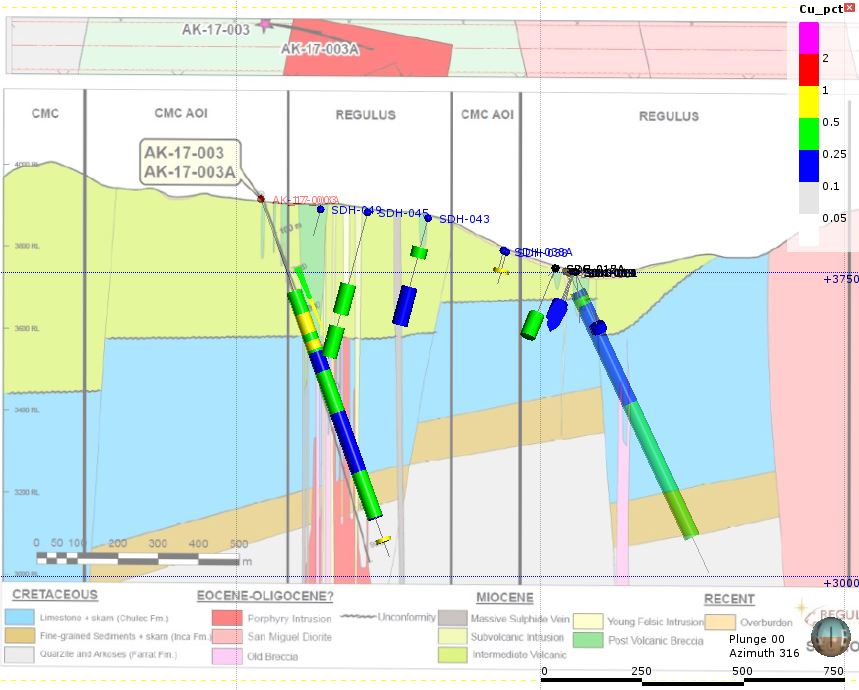
Section - L1050NW - Drill-hole AK-17-003 and 003A

Copper


We can see that the highest copper grades (>0.25%) appear to be found at the contact between the HS-epithermal (in the Light-green Upper Volcanics) and the skarn mineralization (in the Light Blue limestones), and are the discrete >0.25% Cu zones restricted to the narrow, intrusive dykes (pink and red units)?

Gold


It appears that all the gold mineralization is found in the upper HS-epithermal zone. Minimal gold appears to be found in the intrusive rocks).

Arsenic


Here we see As is restricted to the upper HS-epithermal zone with minimal As in the Skarn.

Section - L200NW - Drill-hole DHSF17-161 and AK_17_004 (results pending)

Copper

Again, Cu is restricted to the Skarn (limestones). It is generally low grade, around 0.1 to 0.25% Cu, but there are a couple of narrow, high-grade (>1%) zones that appear to be associated with either the old breccias or narrow Young Felsic units. In the NE, several short holes have intersected narrow Cu-Au mineralization associated with narrow, massive sulfide veins.

Gold

Minimal gold was intersected by hole 17-161, this hole didn't intersect HS-style mineralization within the AK concessions. It will be interesting to see how much HS-mineralization will be hit by hole  AK_17_004.

Arsenic


Again, minimal As is found within the skarn units.


So you can see that the Cu grades are gradually decreasing to the SE, and the elevated zinc assays seems to indicate that hole 17_161 was drilled into the peripheral part of the large Antakori skarn system, suggesting that the high-grade core is probably located to the NW.